OpenAI Math Results: 372 Proofs in One Night, and Nobody Knows Who Gets the Credit
On Tuesday evening, OpenAI posted more new math than some fields produce in a decade.
Not a paper. A dump.
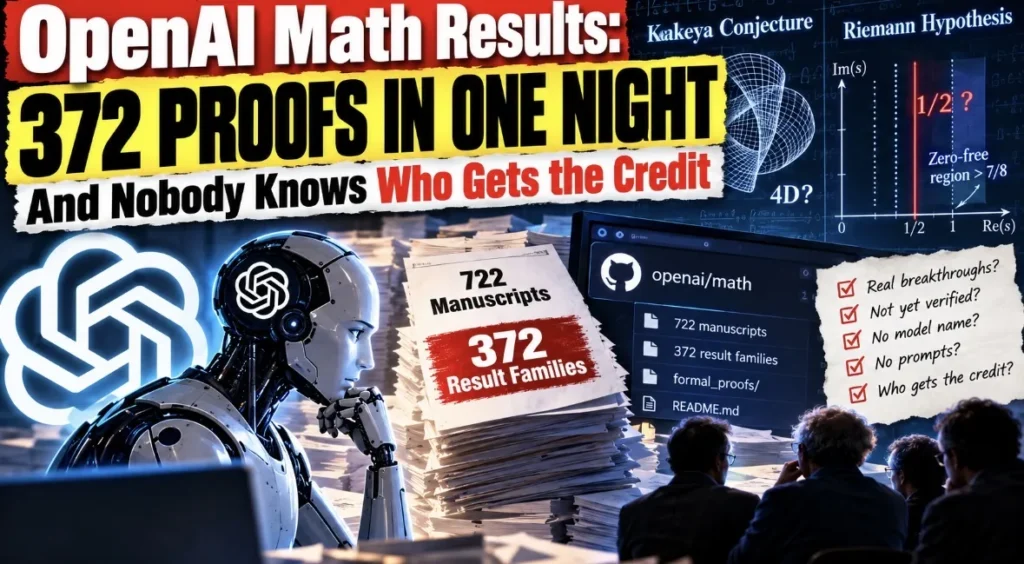
The OpenAI math results landed in a public GitHub repo: 722 manuscripts grouped into 372 “families,” each one claiming to solve or make real progress on an open problem in math or theoretical computer science. All of it came from an internal model OpenAI hasn’t named and hasn’t released.
Mathematicians are torn between awe and fury. Honestly? I get both.
What is actually in the OpenAI math results
Here’s what the company says, straight from its own post and the repo’s README.
The model was handed roughly 4,000 problems. After OpenAI grouped the output and kept only results it judged significant, it ended up with 372 families. On average, each result used about three hours of ChatGPT Pro level “thinking” compute.
Three hours. For problems people have chewed on for decades.
OpenAI told Scientific American that almost every result came from a single prompt given to a single AI agent, though some may have taken several tries. That’s a wild shift from last month, when its Navier-Stokes proof needed a swarm of about 10,000 agents and, by OpenAI’s own estimate, millions of dollars in compute.
One more detail I can’t stop thinking about. OpenAI’s spokesperson said many of these results aren’t yet understood by OpenAI’s own mathematicians.
Let that sink in for a second.
So what’s Kakeya, and did AI solve the Riemann hypothesis?
Two claims are getting all the headlines. Let’s take them in plain English.
Kakeya first. Picture a needle. You want to spin it to point in every possible direction, and you want the shape it sweeps out to take up as little room as possible. Weirdly, you can make that area basically zero. The Kakeya conjecture asks a sharper question: even if the area or volume is tiny, is the set still “full size” in a deeper sense mathematicians call dimension?
In three dimensions, humans cracked that in 2025, when Hong Wang and Joshua Zahl posted their proof. OpenAI’s model claims the four-dimensional version: any set in 4D space holding a line segment in every direction has full dimension four. It also claims a stronger 3D variant.
Big if true. But here’s the catch. The Kakeya papers don’t come with a machine-checked proof. They’re PDFs that humans still have to read.
Now the Riemann hypothesis. No, AI did not solve it.
The Riemann hypothesis is about where the zeros of a famous function sit, and it’s tied to how prime numbers are spread out. It says every interesting zero lies exactly on one line, the line where the real part equals 1/2. The region in question runs from 0 to 1.
What OpenAI’s model claims is a “zero-free” zone: no zeros at all where the real part is bigger than 7/8. It calls this the quasi-Riemann hypothesis. A companion paper proves a weaker 11/12 version a different way.
That’s a real step, and the 7/8 result is formally checked. But 7/8 isn’t 1/2. Think of it as fencing off the right edge of a hallway when the prize is proving everyone’s standing on the center line. Also, per the README, this Riemann work didn’t follow the standard one-prompt process, and the 11/12 write-up was edited by humans.
So anyone telling you “AI solved Riemann” is selling you something.
Can you trust a proof nobody’s read?
This is the part that matters most.
Many of the results come with proofs written in Lean, a programming language that checks every logical step. If Lean accepts a proof, it’s almost certainly correct, as long as the statement it proves matches what the paper claims. The repo’s formalization catalog lists 162 papers with a formalized main result. OpenAI’s README is upfront that the rest aren’t formalized and “could have issues.”
Kevin Buzzard at Imperial College London told New Scientist he counted 30 papers in his area, number theory. Only seven looked impressive to him, and only one was verified in Lean.
“Unfortunately, acceptance of these results by the community will take time, and journalists are going to have to wait while the mathematicians do their job,” he said.
MIT’s Andrew Sutherland was blunter with Scientific American: “We should ask for receipts.”
I’m with them. A correct proof isn’t the same as an important one, and Lean can’t tell you whether something matters.
The credit fight is the real story
This didn’t come out of nowhere.
An experimental OpenAI model got gold-medal level scores at the International Math Olympiad back in July 2025. Then in September, it announced the Navier-Stokes result, and mathematicians Tristan Buckmaster and Levent Alpoge said they’d been working toward something similar using OpenAI’s own Codex. OpenAI says after an investigation that Buckmaster’s prompts “could not have influenced the system in any way.” The argument got nasty anyway. You can read my take on OpenAI’s culture problems if you want the backstory on why people don’t just take its word.
After that mess, an independent advisory group of mathematicians hosted at the Institute for Advanced Study put out guidelines. They asked AI labs to publish the model, the exact prompts and the compute time behind each result.
OpenAI didn’t. It published average compute, 10 reasoning summaries and no prompts. Its spokesperson said the company takes the guidelines seriously but isn’t bound by them.
Here’s my problem with that.
If a human mathematician posted 372 claimed breakthroughs and said “trust me, I won’t tell you how,” nobody would take it seriously. OpenAI gets attention because the results might be right. But “might be right” from a model nobody outside can test is not science yet. It’s a demo.
And the credit question gets uglier every month. Who’s the author of a theorem a model found in three hours? The company? The researchers whose old papers trained it? Nobody?
Why should a normal person care about math proofs?
Fair question. Most of us will never think about Kakeya sets again.
But proofs quietly run your life.
The encryption protecting your bank login rests on number theory, the same world as the Riemann work. Faster algorithms for multiplying matrices make the GPUs inside AI chips more useful, and one family here claims a matrix multiplication bound of 9/4, which is formally checked. Physics, weather models and chip design all lean on math someone had to prove first.
So if a model can really produce new math in hours, that eventually flows into the tech you use. Slowly, and only after humans check it.
What happens when AI out-produces a whole field?
Francis Johnson at University College London spent decades on one of the problems in this batch, Wall’s D(2) problem. He told New Scientist:
“I worked on this problem for 25 years. I produced two books on it. I, personally, gave up.”
Then: “Let’s face it, the genie is out of the bottle now.”
That one hit me.
Toronto’s Daniel Litt sees the upside: “If we want to know the answers to these math questions, I see no reason why we should ask the company to keep them secret from us.” Terence Tao, on the other hand, has called the pace “insane.”
They’re both right. Answers are good. But math was never just about answers. It’s about people understanding why. If we get 372 answers in a night and it takes years to understand them, the bottleneck isn’t discovery anymore. It’s us.
That’s the same shift I wrote about in which AI skills are harder to replace. The machine does the output. The valuable human job becomes checking, explaining and deciding what matters.
What this means for you
- Don’t trust “AI solved X” headlines. Ask what was claimed, what’s checked and who checked it.
- Students, keep learning math. Tao’s advice to the field is to protect real human learning, not hand it to tools.
- If you use ChatGPT for math, remember the public models aren’t this one, and they still make mistakes. Check the work. Same rule as using ChatGPT for writing.
- Watch the release. OpenAI says it’s working to release the model “responsibly.” No name, no date.
My take
This is the most impressive thing I’ve seen an AI do. And the least transparent.
Both can be true.
I want these results to hold up. I also want OpenAI to show its work, the way every human mathematician has to. Until it does, the OpenAI math results are 372 very exciting claims, and a few of them are already proven beyond doubt. That’s a lot. It’s just not everything.
FAQ
Did AI solve the Riemann hypothesis?
No. OpenAI’s model claims a zero-free region where the real part is above 7/8, which it calls the quasi-Riemann hypothesis. That result is checked in Lean. The actual Riemann hypothesis is about the line at 1/2 and remains unsolved.
What are the OpenAI math results?
On October 6, 2026, OpenAI published 722 manuscripts in 372 result families on GitHub, produced by an unreleased internal model. They claim solutions or progress on open problems, including 4D Kakeya and matrix multiplication.
Can AI do math better than humans now?
At speed and volume, OpenAI’s internal model is clearly beyond any single person. Whether its results are important and new is something mathematicians are still checking, and many papers aren’t formally verified yet.
What is Lean in math?
Lean is a programming language and proof checker. Mathematicians write proofs in it, and the computer verifies every logical step, so a Lean-checked proof is almost certainly correct if its statement is right.
Which model made the OpenAI math discoveries?
OpenAI hasn’t named it. It calls it “an internal frontier model” and says it’s working to release it responsibly.
Sources: OpenAI (Sharing AI progress in mathematics), openai/math on GitHub, Scientific American, New Scientist, The Decoder, OpenAI (Navier-Stokes), Quanta Magazine, The Batch.
