
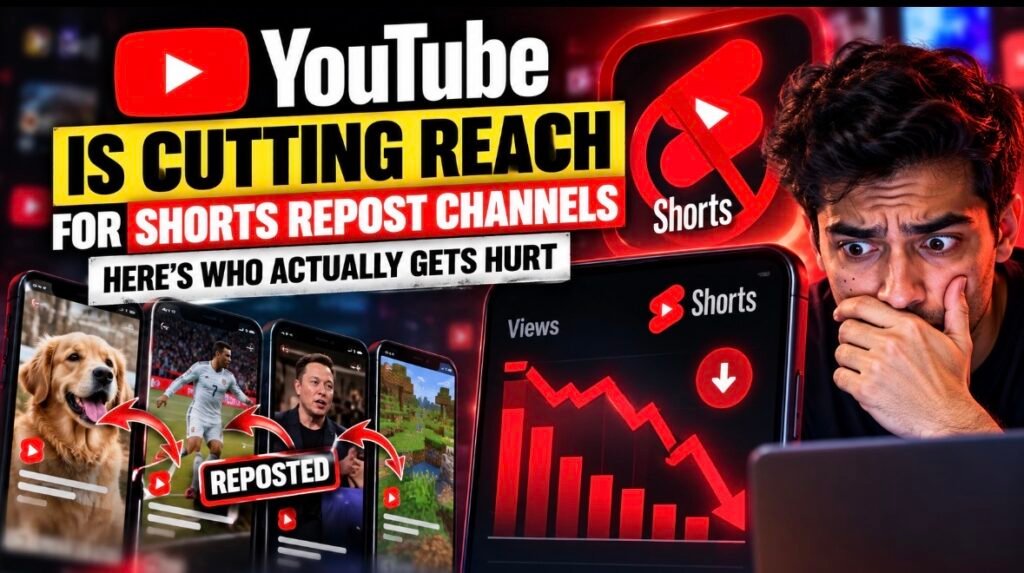
YouTube Is Cutting Reach for Shorts Repost Channels. Here’s Who Actually Gets Hurt
If your YouTube Shorts channel is mostly other people’s clips with a caption slapped on top, your views are about to get a lot quieter.
On October 1, YouTube said it’s updating its Shorts recommendation system to “further prioritize original content and reduce the reach of content re-uploaded from other creators without adding anything of your own.” Creator Liaison Rene Ritchie explained it in a Creator Insider video the same day, and TeamYouTube posted it on the YouTube Help Community.
Nobody’s getting banned. Nothing’s getting deleted. The feed just stops pushing you.
Honestly? I think that’s the right call. But it lands hardest on a group most coverage is skipping: the people who turned clipping into a side hustle. So let’s talk about who’s actually exposed, what YouTube really said, and what a safe Shorts workflow looks like now.
What YouTube actually said
The key line from YouTube’s post is this one:
“Channels identified as primarily aggregating or re-uploading other creators’ videos without significant changes will likely see less distribution within the Shorts feed.”
Three words carry the whole thing.
Channels. YouTube is judging your account as a whole, not one video at a time.
Primarily. Posting a borrowed clip now and then isn’t what they’re targeting. A channel that’s mostly borrowed clips is.
Likely. It’s a ranking signal, not a hard rule. There’s no published threshold, no ratio, nothing you can check against.
YouTube also spelled out what doesn’t count as “adding something.” Its post warns against “minor technical edits or template-based changes simply to alter a video.” According to Search Engine Journal’s writeup of the video, Ritchie went further and said voiceovers that just describe what’s happening on screen don’t cut it either, and neither do template-based bulk changes. What does count: your own commentary, analysis, unique editing, and storytelling.
He also said if you only want your audience to see another creator’s video, share it through your channel’s Posts tab so people watch the original.
What’s still unclear
- No start date. YouTube didn’t say when the new ranking kicks in or whether it’s already live.
- No status screen. There’s no indicator in YouTube Studio telling you your channel has been classified as an aggregator. You’d only see it as a drop in views.
- No recovery timeline. Ritchie said that if a channel shifts toward original content, “the recommendation system will re-evaluate reach.” He didn’t say how long that takes.
- Nothing about paid clipping deals. The announcement doesn’t say whether it matters if the original creator gave you permission or paid you to post their clips.
That last one is the big blind spot.
This is about reach, not your paycheck (directly)
A lot of people are mixing two separate things up.
The October 1 change is about recommendations. Monetization is still governed by YouTube’s separate reused content policy, which already says that if you borrow content, you need to change it significantly to make it your own.
Remember the panic in July 2025? YouTube renamed its “repetitious content” monetization rule to “inauthentic content,” and half the internet decided faceless and AI channels were finished. Ritchie put out a video saying the rename was a minor update aimed at mass-produced, repetitive content, and that there were no changes to the reused content rules for clips, compilations, and reactions.
So the picture for a pure repost channel now looks like this:
- It could already fail the monetization review under the reused content rules.
- Its views may not count toward Shorts revenue anyway, since the Creator Pool is based on qualifying engaged views.
- Now it also gets shown to fewer people.
And there’s a fourth squeeze coming. YouTube announced in August that starting February 1, 2027, new channels need 20 million qualified Shorts views in 90 days (up from 10 million) or 8,000 watch hours (up from 4,000) to join ad revenue sharing. Channels will also need 10 million qualified Shorts views over 90 days to keep earning from Shorts ads. Less reach plus higher bars is a rough combo for anyone running on borrowed clips.
Who actually gets hurt
The obvious answer is meme pages. I think the damage spreads wider.
The clipping side-hustle crowd
Clipping is a real business now. Streamers, podcasters, and brands run campaigns on platforms like Whop’s Content Rewards, where clippers cut long videos into Shorts and get paid per 1,000 views. Marketers told Business Insider earlier this year that clippers usually get $1 to $4 per 1,000 views, as reported by Mashable. A board check by FastClip in late September found the median public campaign paying about $1.
At $1 per 1,000 views, you need a million views to make $1,000. That math only works if the algorithm keeps feeding your clips to strangers. Cut reach, and the payout shrinks with it.
Here’s the twist. A lot of these clips are authorized. The streamer wants them out there. But YouTube’s wording is about re-uploading “other creators’ videos” without significant changes, and it says nothing about permission. Until YouTube clarifies that, I’d assume permission doesn’t protect you from the ranking change. (Permission does matter for copyright. Content ID claims and takedowns are a separate system and aren’t changing here.)
Faceless AI channels
The ones that scrape clips and add a robotic voice reading out what’s on screen are directly in the line of fire, because that’s almost exactly what Ritchie described as not enough. If you’re not sure where the line between using an AI tool and mass-producing filler sits, my explainer on what generative AI actually is is a decent starting point. The tool isn’t the problem. Using it to churn out the same video 200 times is.
And if you’ve been eyeing one of those AI agents that auto-clip, caption, and upload on a schedule, think twice. “Template-based bulk changes” is pretty much a description of what those pipelines do by default.
Brand accounts reposting creator content
Some brands fill their Shorts tab with cut-downs from paid creator deals. If those clips carry nothing new, they could fall into the same bucket. The simple fix is to have the creator post from their own channel.
Who’s probably fine
Long-form creators clipping their own videos. YouTube’s language is specifically about other creators’ videos, and coverage from Android Authority reads it the same way. Ritchie’s video reportedly didn’t address self-clipping directly, but nothing in the announcement points at it.
Likely hit vs probably fine
| Likely hit | Probably fine |
|---|---|
| Full podcast moments reposted with just a caption | Your own long videos cut into Shorts |
| Livestream highlights with zero commentary | A clip you react to with a real opinion |
| AI voiceover describing someone else’s footage | A clip used to explain or teach something |
| Same template applied to 50 clips a day | Original footage, even if it’s simple |
| Compilations of other creators’ viral moments | Remixes made with YouTube’s own Shorts tools, with real changes |
A quick self-check for your channel
Open YouTube Studio, look at your last 30 uploads, and be honest:
- Is more than half of it someone else’s footage?
- If you muted the original audio, would your video still make sense?
- Would a viewer learn something, or hear an opinion, they couldn’t get from the original?
- Could someone tell your channel apart from 10 others posting the same clip?
- Are you doing anything a template can’t?
If you answered badly on three or more, you’re probably the channel YouTube is describing.
Also worth doing: sort your Shorts by views and compare reposted clips against your original ones over the next month. A gap that opens after October 1 is your earliest warning sign.
How to turn a repost channel into something YouTube wants
You don’t need to burn the channel down. You need to change what you add.
- Lead with your take, not the clip. Open with your opinion in the first two seconds, then show the moment as evidence.
- Cut the clip shorter. Use 5 to 10 seconds of the original, not 45. The rest should be you.
- Add context people don’t have. Who is this, why does it matter, what happened next?
- Stack sources. Put two or three clips side by side to make a point. That’s analysis, not reposting.
- Get on camera or at least on mic. Your actual voice with an actual opinion, not a narration of what’s on screen.
- Mix in fully original Shorts. Even simple ones. Remember, YouTube is judging the channel, not single videos.
- Use the Posts tab for pure shares. If you just want people to see something cool, link the original there.
Will this take more time per video? Yes. That’s kind of the point. The “upload 20 clips a day” model was always borrowing someone else’s work and hoping nobody noticed. YouTube noticed.
My honest read: this is good news if you make your own stuff, and a wake-up call if your whole plan was other people’s moments. Instagram and Facebook already did their own versions of this, so it’s not like YouTube is the strict one here. It’s catching up.
FAQ
Is YouTube banning clipping channels?
No. YouTube isn’t removing videos or handing out strikes under this update. Channels that mostly repost other creators’ clips without significant changes will likely get less distribution in the Shorts feed.
Does this affect monetization?
Not directly. The October 1 update is about recommendations. Monetization still follows YouTube’s reused content policy, which already requires significant changes to borrowed content. Less reach can still mean less money, though.
Can I still clip my own long-form videos?
YouTube’s wording targets re-uploads of other creators’ videos, so clipping your own content doesn’t appear to be the target. YouTube hasn’t addressed it directly.
When does the change start?
YouTube didn’t give a date. It announced the update on October 1, 2026, but hasn’t said whether it’s already live or how long a channel’s reach takes to be re-evaluated.
Does permission from the original creator protect me?
YouTube hasn’t said. Permission helps with copyright claims, but the announcement doesn’t mention authorized or paid clipping, so I wouldn’t count on it.
Sources: YouTube Help Community (TeamYouTube), Search Engine Journal, Social Media Today, PPC Land, Mashable, Android Authority, Firstpost, YouTube Blog (YPP changes), Social Media Today (July 2025 clarification), FastClip.
