
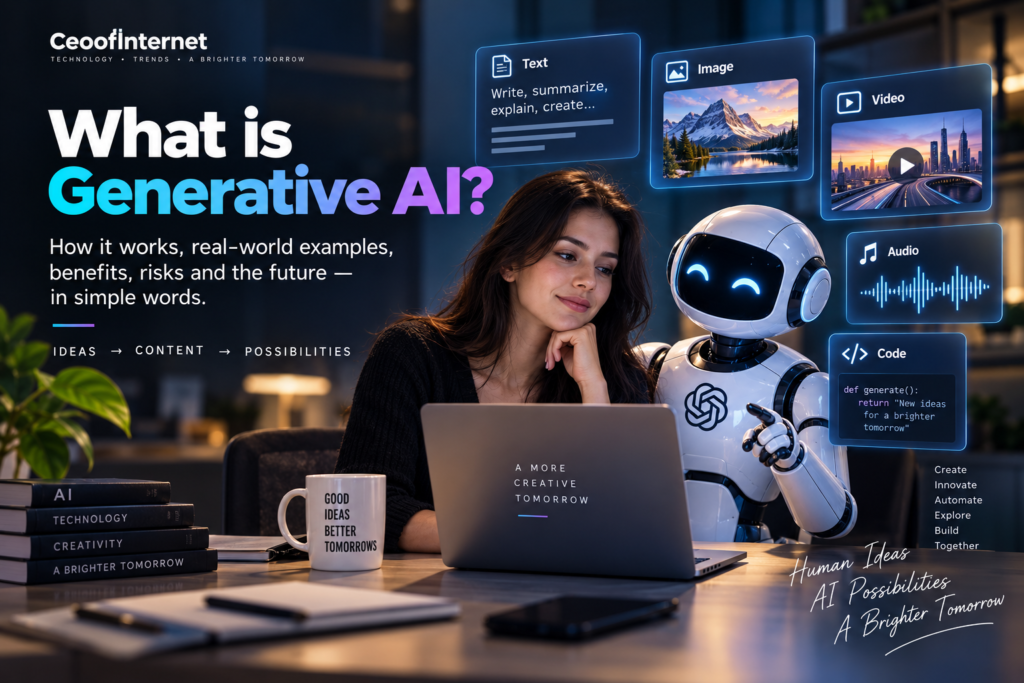
What Is Generative AI? How It Works, Examples, Benefits, Risks, and the Future
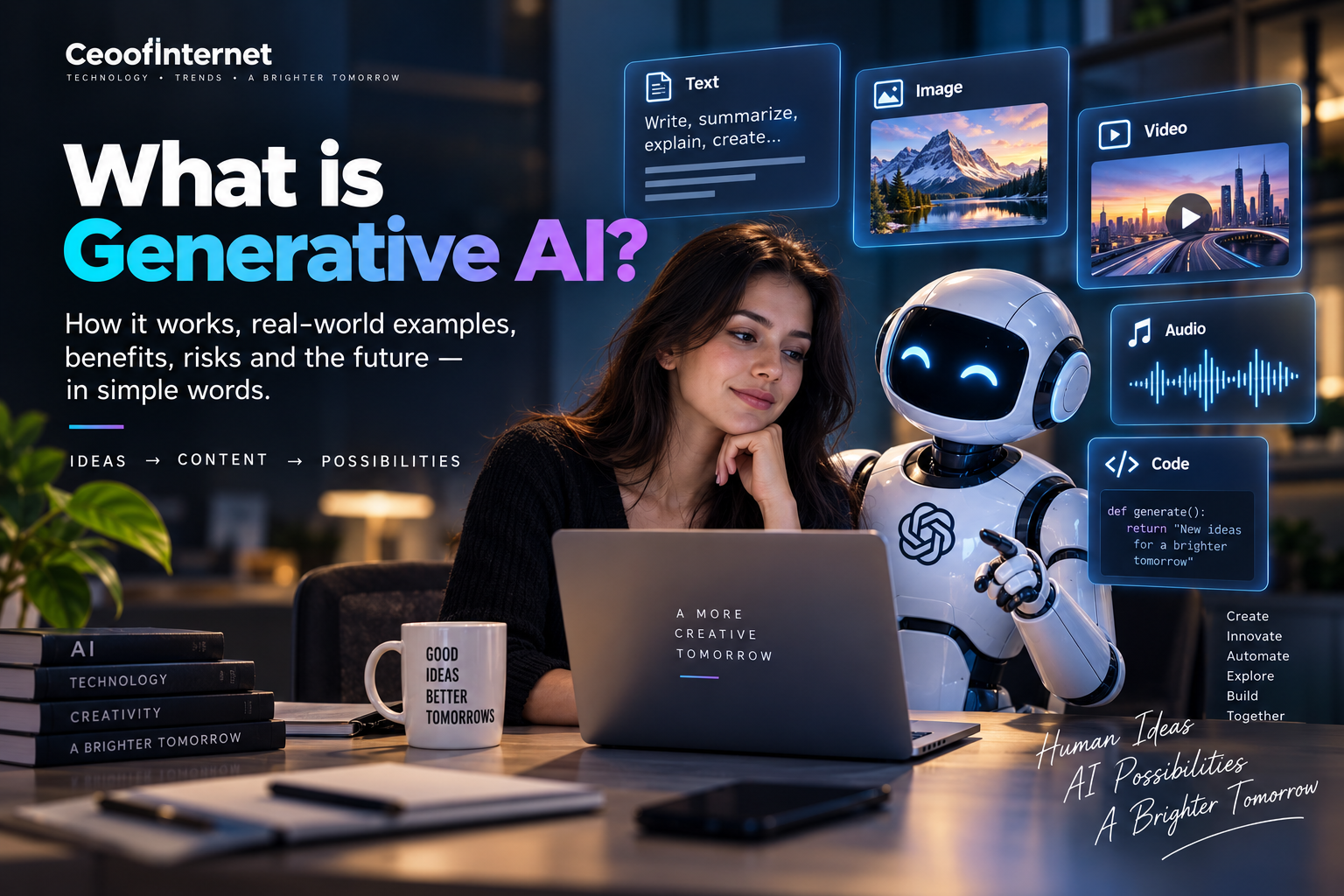
Generative AI has quickly become one of the most transformative technologies in the world. It can write emails, create images, generate video, produce code, summarize complex documents, answer questions, and compose music.
But what exactly is generative AI, how does it work, and how does it differ from traditional artificial intelligence?
This guide breaks down generative AI in plain English—with practical examples—so you can understand what it can do, what it cannot do, and how to use it effectively.
What Is Generative AI?
Generative AI is a class of artificial intelligence models that create new content based on patterns learned from training data.
That content can include:
- Text
- Images
- Video
- Audio and speech
- Music
- Computer code
- Synthetic data
- 3D assets
The U.S. National Institute of Standards and Technology (NIST) defines generative AI as a class of AI models that can generate derived synthetic content, including text, images, video, and audio.
Put simply:
- Traditional AI analyzes, classifies, or predicts.
- Generative AI creates.
For example, a traditional AI system might classify whether an image contains a dog. A generative AI system can generate an entirely new image of a dog from a text prompt.
Generative AI Explained with a Simple Example
Imagine you enter this prompt:
“Write a short story about a robot exploring Mars.”
The AI does not search the internet to copy and paste an existing story. Instead, it uses statistical patterns learned across billions of text samples to generate an original sequence of words tailored to your request.
The core pipeline looks like this:
Prompt → AI Model → Generated Output
The same principle applies across media:
- Prompt: “A futuristic city at night, neon reflections in rain.” → AI Image Model → New Image
- Prompt: “Write Python code to calculate compound interest.” → AI Code Model → Executable Script
How Does Generative AI Work?
You don’t need an advanced math degree to grasp the core architecture. At a high level, the process moves through five key stages:
Data → Training → Foundation Model → Prompt → Output
- Data Collection: Systems train on massive datasets of text, images, audio, video, or source code.
- Training: The model identifies statistical weights and relationships within that data. A language model learns how words and concepts relate; an image model learns visual structures, lighting, and textures.
- Foundation Models: Modern applications typically build on top of foundation models—broad, general-purpose engines trained on vast data that can be fine-tuned for specific downstream tasks.
- Prompting: You give the system an instruction or query (the prompt), such as “Explain quantum computing to a high schooler.”
- Generation & Inference: Using the prompt and its learned parameters, the model predicts the most probable, coherent output token by token or pixel by pixel.
What Is a Generative AI Model?
A generative model is the underlying machine learning architecture capable of producing content. Models are often categorized by the medium they specialize in:
| Type of AI Model | Primary Output | Typical Use Cases |
|---|---|---|
| Language Model (LLM) | Text | Writing, analysis, reasoning, Q&A |
| Image Model | Still images | Concept art, marketing assets, design mockups |
| Video Model | Video clips | Animation, cinematic b-roll, prototyping |
| Audio Model | Speech & sound | Voiceovers, sound design, translation audio |
| Music Model | Musical compositions | Background tracks, beat production |
| Code Model | Programming code | Syntax generation, debugging, refactoring |
| Multimodal Model | Multiple modalities | Processing text + images together as input/output |
Generative AI vs. Traditional AI & Machine Learning
Understanding how generative AI fits into the broader technical landscape clears up significant confusion:
Artificial Intelligence → Machine Learning → Deep Learning → Generative AI
- Artificial Intelligence (AI) is the overarching field dedicated to building systems that perform tasks requiring human-like intelligence.
- Machine Learning (ML) is a technical approach within AI where systems learn patterns directly from data rather than following rigid, hand-coded rules.
- Deep Learning is a subset of ML based on multi-layered artificial neural networks.
- Generative AI is a specialized application of deep learning focused on creating outputs rather than just categorizing them.
Generative AI vs. Traditional (Predictive) AI
| Traditional AI | Generative AI |
|---|---|
| Analyzes and evaluates existing information | Creates entirely new artifacts and content |
| Classifies data (e.g., spam vs. not spam) | Drafts emails and messages from scratch |
| Predicts trends (e.g., housing prices) | Writes reports summarizing predictive data |
| Detects objects in an image | Renders new images from text descriptions |
| Recommends products based on history | Writes personalized product descriptions |
| Flags fraudulent transactions | Generates synthetic fraud scenarios for testing |
What Are Large Language Models (LLMs)?
A Large Language Model (LLM) is a type of generative AI trained specifically on vast amounts of natural language.
LLMs power modern assistants and handle tasks such as:
- Answering technical and contextual questions
- Drafting and editing long-form copy
- Translating across dozens of languages
- Synthesizing multi-page reports into bullet points
- Writing and debugging computer code
Note: All LLMs are generative AI, but not all generative AI systems are LLMs. A model that creates images or audio from scratch is generative AI, but it is not a language model.
What Is a Prompt (and How Do You Write a Good One)?
A prompt is the instruction or context you provide to an AI model. Vague prompts yield generic answers; detailed prompts yield high-utility responses.
The 5-Part Prompt Framework: Role + Task + Context + Constraints + Output Format
- Weak prompt: “Write about smartphone cameras.”
- Strong prompt: “Act as a tech journalist. Write an 800-word beginner guide explaining how smartphone cameras work. Compare optical vs. digital zoom, use everyday analogies, and format the output with markdown subheadings.”
Practical Applications Across Industries
Generative AI is shifting from isolated chatbot experiments to integrated workflow tooling:
- Content Creation: Drafting outlines, scripts, emails, and initial blog posts. (Best practice: Use AI for drafts, but rely on human editorial judgment for fact-checking and unique perspective.)
- Software Engineering: Writing boilerplate code, translating code between languages, diagnosing bugs, and creating unit tests.
- Visual Design & Media: Concept art, storyboard generation, product mockups, and video prototyping.
- Education & Tutoring: Socratic study partners, dynamic quiz generation, and adaptive explanations adjusted to specific reading levels.
- Enterprise & Business: Automated customer support workflows, internal wiki search, contract analysis, and data synthesis.
- Scientific Research: Accelerating molecular modeling, protein folding analysis, and summarizing clinical literature.
Key Benefits of Generative AI
- Accelerated Production: Reduces the time required to draft initial materials from hours to seconds.
- Lowered Technical Barriers: Allows non-technical users to build prototypes, automate tasks, or write scripts using plain language.
- Dynamic Personalization: Generates variations of explanations, learning modules, or copy tailored to specific audiences.
- Rapid Prototyping: Enables teams to test creative and architectural concepts cheaply before investing significant capital.
Limitations and Risks
Generative AI is a probabilistic tool, not an oracle. Understanding its failure modes is critical:
- Hallucinations: Models can generate statements that sound confident and authoritative but are completely fabricated—inventing citations, statistics, or historical events.
- Bias Amplification: If training data contains demographic, cultural, or occupational biases, the output often mirrors or exaggerates those distortions.
- Data Privacy & Security: Sensitive corporate data, private customer details, or proprietary source code pasted into consumer AI tools may be logged or used for future model training depending on terms of service.
- Copyright & Intellectual Property: Questions surrounding whether training on copyrighted material constitutes fair use remain active legal debates across global jurisdictions.
- Deepfakes & Misinformation: The ability to produce hyper-realistic synthetic video, audio clones, and convincing text makes social engineering and disinformation campaigns easier to scale.
Does Generative AI “Think”?
No. Generative AI does not possess consciousness, intention, or genuine comprehension.
It operates probabilistically: it calculates which word, pixel, or audio frequency is most likely to follow the preceding context based on mathematical representations built during training.
An AI can explain an intricate distributed system accurately in one sentence, then fail at basic arithmetic in the next. Treat it as a capable computational amplifier, not a substitute for human intellect.
A Practical 5-Step Workflow for Generative AI
To get consistent value from generative tools without falling victim to errors:
- Define Objective & Audience: Give the model clear boundaries, persona, and output requirements.
- Generate the First Pass: Treat AI output as a rough first draft, not a finished product.
- Stress-Test the Output: Prompt the model against itself: “Critique this draft. What edge cases or counterarguments were missed?”
- Independently Verify Facts: Never take data, citations, or technical assumptions at face value; check them against primary sources.
- Inject Human Perspective: Add your own voice, proprietary data, real-world experience, and editorial polish.
The Future: Agents and Multimodal Systems
Generative AI is rapidly evolving past simple single-turn text boxes.
The near future focuses on two central developments:
- Multimodality as Default: Models that seamlessly ingest and produce audio, video, text, charts, and code simultaneously within a single context window.
- Autonomous AI Agents: Systems that do not just return text, but chain actions together using software tools—such as researching a problem, reviewing an attached dataset, verifying its own conclusions, and generating a validated pull request.
Frequently Asked Questions
What does generative AI mean in simple terms?
Generative AI refers to algorithms designed to create new, original content—such as articles, images, voiceovers, or code—by learning the underlying patterns of human-created data.
Is ChatGPT generative AI?
Yes. ChatGPT is an application built on generative large language models.
Can generative AI replace human workers?
Generative AI automates discrete tasks rather than entire professions. High-value work is shifting toward strategic oversight, prompt direction, system architecture, and editorial verification.
Can generative AI be used for commercial projects?
In most cases, yes, provided your use complies with the specific software tool’s commercial terms and local intellectual property regulations.
Quick Reference Glossary
- Generative AI: AI systems that generate new content based on learned data patterns.
- Foundation Model: A massive model trained on broad data that serves as the base for specialized tools.
- Large Language Model (LLM): A deep-learning model engineered to understand, process, and generate human language.
- Multimodal AI: An AI architecture capable of processing and generating multiple media formats (text, image, audio) concurrently.
- Hallucination: An incorrect, fabricated, or nonsensical output presented confidently by an AI model.
- Prompt Engineering: The practice of structuring and refining inputs to elicit optimal outputs from AI systems.
Further Reading & Authoritative Resources
- NIST: Generative AI Glossary — Standardized terminology and definitions from the U.S. National Institute of Standards and Technology.
- NIST: Generative AI Risk Management Profile — Practical guidelines for identifying and mitigating generative AI risks.
- IBM: What is Generative AI? — Foundational breakdown of models, architecture, and enterprise use.
- AWS: Generative AI Overview — Practical explanations of machine learning infrastructure and cloud integration.
Also explore on CeoofInternet: What Is Artificial Intelligence? and Learn AI.
