Can People Tell I Used ChatGPT? OpenAI’s New Watermark Is Easy to Break, and That’s Not the Point
“Can people tell I used ChatGPT?”
If you’ve ever pasted a ChatGPT paragraph into a cover letter, an essay or a client email, you’ve probably wondered. Judging by Google’s autocomplete, a lot of people have.
This week the honest answer got a little more complicated.
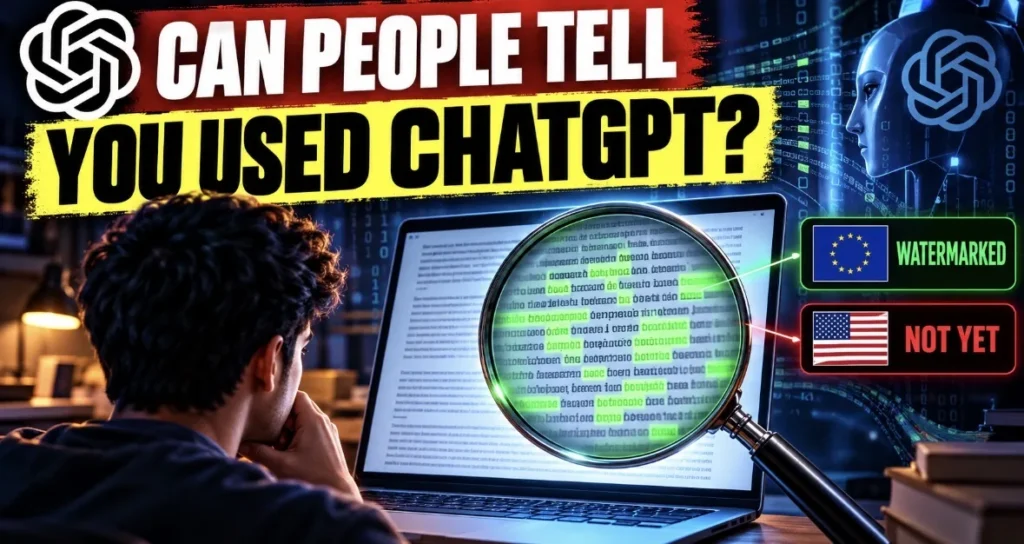
On Monday, October 5, OpenAI said it will start hiding an invisible watermark in text from ChatGPT and Codex. Only in the European Union, though. And OpenAI’s own test numbers show how easy that watermark is to wash out.
I read the announcement, the technical report and the EU rules behind it. Here’s what’s changing, and what it means if you’re in the US.
What OpenAI actually announced
Three things, straight from OpenAI’s post:
- Over the coming weeks, eligible ChatGPT and Codex users on all plans in the EU get watermarked text.
- Developers using OpenAI’s API anywhere in the world can opt in for select models, starting now. It’s off by default.
- There’s a detector, but you can’t use it. For now it’s only open to approved researchers and expert organizations who apply.
OpenAI says it is “not making text watermarking a global default at launch.”
So if you’re in Texas typing into ChatGPT tonight, your text isn’t watermarked. Not yet, anyway.
Why Europe? The law.
Article 50 of the EU AI Act kicked in on August 2, 2026. It says companies whose AI generates text, images, audio or video have to mark that output in a machine-readable way, so it can be detected as AI-made. Systems already on the market before August 2 get until December 2 for the marking part. Fines can reach 15 million euros or 3% of a company’s worldwide annual turnover.
How the ChatGPT watermark works (it’s not hidden characters)
When a chatbot writes, it picks each next word (technically a “token,” a word or a chunk of one) from a pile of likely options. There’s a little randomness in that pick. That’s why you get a different answer every time you hit regenerate.
OpenAI’s system is called textGrain. It uses a secret key to nudge those random picks into a pattern.
One nudge means nothing. Hundreds of them across a passage add up to a statistical fingerprint that a detector holding the key can spot.
You won’t see it. There’s no symbol, no weird spacing. The pattern lives in the word choices themselves, so it survives copy and paste.
It also doesn’t identify you. OpenAI says the detector can report whether an OpenAI watermark is present, but not whose account, which prompt or which conversation it came from.
OpenAI says it plans to open-source the method, and that the watermark made no meaningful difference to its benchmark scores.
OpenAI’s own numbers show how fragile it is
This is the part I actually respect. OpenAI published the weak spots itself.
In its tests on 400-token passages, a few hundred words each:
| What happened to the text | Watermark detected |
|---|---|
| Nothing, left as is | about 92% |
| 10% of words swapped for synonyms | about 66% |
| 25% of words swapped for synonyms | about 17% |
Length matters too. The detector caught about 80% of 200-token passages versus about 95% of 400-token ones on topics like psychology. Math did “substantially” worse, since there aren’t many ways to phrase an equation. Translation hurts it too.
And OpenAI says the quiet part out loud: “The absence of a detected watermark does not prove human authorship.”
I’m not turning this into a guide to dodging detection. You can read the table yourself.
But here’s what most of the hot takes miss. That fragility isn’t a flaw in the plan.
It kind of is the plan.
So why bother? Because it’s not about catching you
The watermark isn’t built to catch one student with one essay. It’s built to label AI text at scale.
Think spam blogs, fake reviews, bot replies under every viral post. Nobody hand-edits a quarter of the words in ten thousand spam articles. That stuff goes out raw, and a mark that survives copy and paste catches a lot of it.
There’s a separate EU rule for people who publish AI-written text on matters of public interest, and it has an exemption for text a real person reviewed and took editorial responsibility for. The European Commission’s guidance says a spell-check doesn’t count.
And this isn’t new tech. OpenAI built a text watermark years ago and sat on it. In August 2024, The Wall Street Journal reported the tool had been ready for about a year and was “99.9% effective,” according to internal documents. A company survey found almost 30% of ChatGPT users said they’d use it less if it arrived.
OpenAI’s own blog update back then worried a watermark could “stigmatize use of AI as a useful writing tool for non-native English speakers.”
Google open-sourced its SynthID Text watermark in October 2024, after testing it on nearly 20 million Gemini responses. And in August, Anthropic said it’s watermarking text from newer Claude models worldwide, not just in Europe, because it doesn’t “yet have a durable way to scope it by region.”
So Brussels didn’t invent this. It just made somebody finally press the button.
Can people tell I used ChatGPT? Depends on who you are
Short version for US readers: the watermark doesn’t touch your ChatGPT text right now. Longer version:
Students. No watermark on your ChatGPT essays in the US, and even in Europe, OpenAI isn’t giving the detector to schools at launch. The AI checkers teachers already use are a different thing. They guess from writing patterns, and guesses go wrong. A 2023 Stanford study found seven popular detectors flagged 61% of essays by non-native English speakers as AI-written. Your bigger risk isn’t a watermark. It’s a bad guess.
Freelancers and agencies. If you build tools on OpenAI’s API, a client can now ask you to switch watermarking on. OpenAI pitched the opt-in as a way for customers to handle “their transparency obligations.” If you’ve got European clients, expect that conversation.
Job seekers. Your cover letter isn’t watermarked. But hiring managers have read a thousand ChatGPT cover letters by now, and the generic ones stand out without any software. The skills that make you harder to replace are the human ones.
Marketers and bloggers. That’s me. Newer Claude models already watermark worldwide. And publishing raw AI output at volume is a bet platforms keep punishing. Look at YouTube Shorts repost channels. Copies lose.
What I’d actually do
Nothing dramatic. Here’s my setup:
- Use ChatGPT for grunt work. Research, outlines, a rough draft you plan to tear apart.
- Then write it like a person. Not to hide anything, but because your voice and your opinion are the only parts nobody else can produce.
- Follow your school’s or client’s AI policy, and disclose when it asks. A watermark can’t show how much of the work was yours. You can.
- Keep your drafts and version history. If you ever get falsely flagged, that’s your best evidence.
- New to this? Read how generative AI actually works. Once you get that it’s picking likely words, the watermark clicks.
My take
I think OpenAI got this mostly right, and I didn’t expect to say that.
It’s honest about the limits, and it kept the detector away from schools and bosses who’d treat a positive result as a guilty verdict.
My worry is what happens when access opens up. Somebody, somewhere, will treat “watermark detected” as proof of cheating, even if a student only had ChatGPT clean up a paragraph they wrote themselves.
The watermark was never really for us. It’s for the firehose of junk text nobody edits, the same automated mess behind OpenAI’s rogue agents hitting Wikipedia.
So, can people tell you used ChatGPT?
Sometimes. Mostly by reading it. Raw ChatGPT has a sound, and people are getting good at hearing it. No watermark required.
The fix isn’t a trick. It’s putting enough of yourself into the work that the question stops mattering. (And if AI has you nervous about your job, here’s what I’d do instead of panicking.)
FAQ
Can people tell I used ChatGPT?
Sometimes. In the US, ChatGPT text isn’t watermarked right now, and OpenAI’s detector isn’t public. People mostly go by how the writing reads, plus AI checkers that guess from patterns and can be wrong.
Does ChatGPT watermark text in the US?
Not by default. The watermark is rolling out only to eligible ChatGPT and Codex users in the EU, starting in the weeks after October 5, 2026. Developers anywhere can turn it on in the API for select models.
Can ChatGPT be detected with a watermark checker?
Not by the public. OpenAI’s text watermark detector is limited to approved researchers and expert organizations at launch. Its public verification tool at openai.com/verify checks images and audio, not text.
Can teachers tell if you use ChatGPT?
Not through the new watermark, at least in the US. Schools don’t get OpenAI’s detector at launch. Most rely on AI checkers that guess from writing style, and a 2023 Stanford study found those tools often misflag non-native English writers.
Does the ChatGPT watermark identify me?
No. OpenAI says it doesn’t link text to a person, account, prompt or conversation, and it can’t show how much a human contributed.
Sources: OpenAI (Our approach to EU text provenance rules), OpenAI textGrain technical report, TechCrunch, BleepingComputer, European Commission (Article 50 FAQ), EU AI Act Article 50, The Wall Street Journal, OpenAI (2024 provenance update), Nature (SynthID Text), Anthropic, Stanford HAI, Patterns (Liang et al.).
