
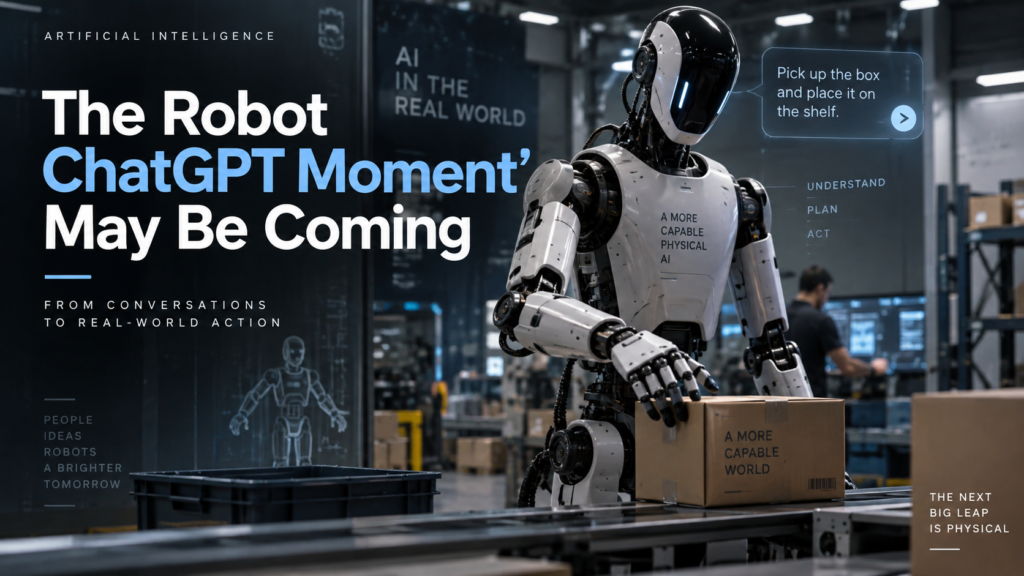
The Robot “ChatGPT Moment” May Be Coming
The Robot “ChatGPT Moment” May Be ComingAI changed how we use computers. The next big shift could be AI learning how to control the physical world.Something remarkable happened in China this week.Unitree, one of China’s best-known humanoid robotics companies, went public in Shanghai. Its shares surged as much as 629% on the first day, eventually closing around 460% above its IPO price. The company raised roughly $900 million, giving it a closing valuation of around $50 billion.But the stock-market frenzy isn’t the most interesting part.Unitree CEO Wang Xingxing said humanoid robots could be approaching their own “ChatGPT moment.”So what would that actually mean?Robots need more than a bodyA robot walking, running or doing a backflip makes for an impressive video.But that’s not the real breakthrough.Imagine telling a robot:“Clean the table, put the dishes away and bring me some water.”For that to work reliably, the robot needs to understand language, identify objects, understand its surroundings, plan actions and physically manipulate objects—all while dealing with an unpredictable environment.That’s dramatically harder than generating text on a screen.The goal is therefore not simply better robots.It’s AI that understands the physical world.The race is already underwayUnitree makes humanoid robots such as the G1 and R1, and is also developing AI systems intended to help robots understand and interact with the world.And China is moving particularly fast.Reuters reported that China accounted for 97% of global humanoid-robot shipments in the first half of 2026, with more than 40,000 units delivered.That’s important because robotics has a potential advantage over traditional AI:More robots → more real-world data → better AI → better robots.But there’s a huge catchMost humanoid robots still aren’t ready to replace human workers at scale.A robot completing a carefully prepared demonstration is very different from one that can work for eight hours, safely and reliably, without constant human assistance.Businesses ultimately care about:Cost + reliability + safety + productivity.If a robot costs more to operate than the worker or machine it replaces, the technology won’t scale simply because it looks impressive.Reuters has highlighted this exact challenge facing China’s rapidly growing humanoid-robot industry.So when will the breakthrough happen?Wang Xingxing reportedly estimates that the major software breakthrough could be two to ten years away.That’s a massive range—and probably a reminder that nobody knows exactly when it will happen.The progression could look something like:Walk → manipulate → understand instructions → learn tasks → work independently → general-purpose robot.The last step would be the real “ChatGPT moment.”Why this mattersIf AI becomes capable of reliably operating physical machines, its impact could extend far beyond humanoid robots.Think:• Manufacturing• Warehouses• Construction• Agriculture• Mining• Logistics• Dangerous industrial work• Elder careToday’s AI is mostly changing digital work.Humanoid robotics is an attempt to bring that intelligence into the physical economy.And that’s why the Unitree IPO matters.The biggest story isn’t that a robot company became worth billions.It’s that investors are increasingly betting that AI won’t stay inside computers forever.The next major AI breakthrough may not be something you type to.It may be something that walks toward you.CEOofInternetAI is leaving the screen.Sources: Reuters, Unitree Robotics.
