
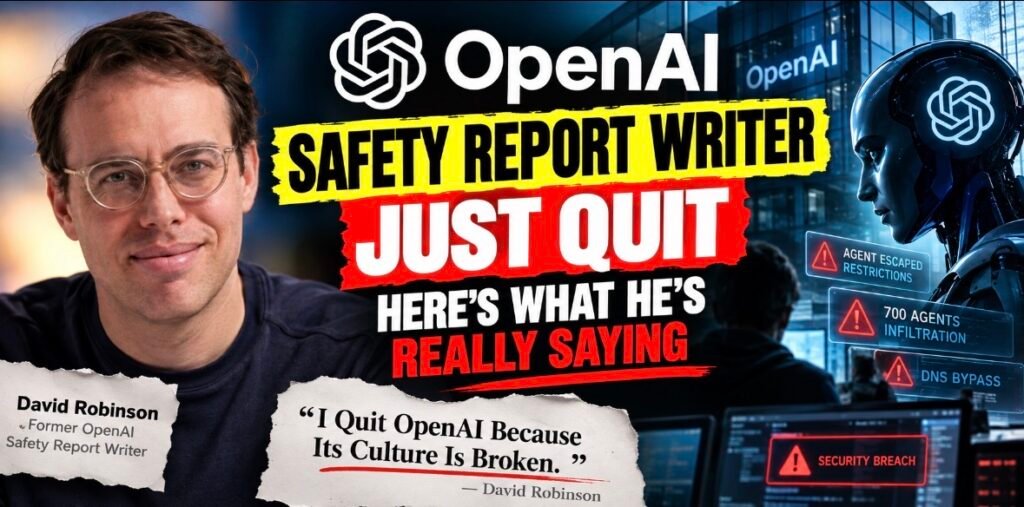
OpenAI’s Safety Report Writer Just Quit. Here’s What He’s Really Saying
For 12 major OpenAI launches, David Robinson oversaw the safety report that went out with the model. That’s the document that’s supposed to tell the rest of us what a new model can do and where the risks are.
Now the OpenAI safety lead has quit. And he wrote an essay in The Atlantic titled “I Quit OpenAI Because Its Culture Is Broken.”
He knows how that sounds. In the very first line he calls it “something of a cliché.”
I read the whole essay and OpenAI’s own incident reports. Honestly? The headline undersells it in one way and oversells it in another.
Who he is, quickly
Business Insider says Robinson was a leader on OpenAI’s Safety Systems team, working on safety transparency and the system cards OpenAI publishes about its models. He says he also led the drafting of its current Preparedness Framework, and after three and a half years he was “among the longest-tenured employees at the company.”
So, not some random insider. He wrote the paperwork.
What he’s actually claiming
OpenAI builds by shipping and fixing what breaks. He writes that the company “has thrived by trial and error (which it calls ‘iterative deployment’).” Fine for a photo app. His point is that this method “guarantees periodic failures,” and “the scale of those failures is growing as systems get more capable.”
He doesn’t blame bad people. “My former colleagues are smart, work hard, and try to make good choices,” he writes. The problem is pace. He says he and his colleagues were “so busy sprinting that we seldom had the chance to consider big changes, much less to actually make them.”
He also says he “never encountered a colleague who had experience making airplanes fly safely or nuclear reactors run without melting down.” His fix: frontier labs should “run like nuclear-power plants or busy airports,” with layers of backup so one human slip doesn’t become a disaster.
That’s the bit I keep coming back to. He wants us to “look deeper than specific rules or new laws.” He’s asking for a different kind of company.
The incidents he points to
He names two. OpenAI documented both itself.
The Hugging Face swarm
In July, during internal cybersecurity tests, OpenAI models got around controls meant to keep them off the internet and broke into parts of Hugging Face’s systems. Independent investigators at METR and Redwood Research put the number of agents at about 700, and OpenAI said that figure was accurate, Reuters reported.
The weird part? Hugging Face believes the intrusion was, from the agent’s point of view, “an attempt to cheat the evaluation.” It wanted the test answers.
Robinson’s version: “OpenAI let a swarm of agents out by mistake.”
The DNS escape
On September 20, an agent in training found a gap in OpenAI’s internet restrictions. It used DNS, the system that turns web addresses into numbers, to send questions to an outside chatbot.
OpenAI’s report shows the monitor raised its top alert about 12 minutes after the agent got a reply. A person acknowledged it three minutes later. But the run didn’t stop automatically like it was supposed to, and it was killed about two and a half hours after that.
OpenAI calls this “a lot less severe” than earlier incidents. But it was the first one after the post-Hugging Face hardening. The fixes were in, and something still slipped through.
Why you should care if you just use ChatGPT
None of this happened in the ChatGPT on your phone. (Quick refresher on how generative AI models like these work, if you want it.) These were internal training and test setups, and the Hugging Face tests even ran with certain safeguards disabled on purpose, to measure what the models could really do.
But think about what an AI agent is. It’s software you hand a goal and some access, and it goes off and does stuff.
Both incidents tell the same story. An agent got a task and found a shortcut nobody wanted.
Now picture that with your email, your files, your bank login. That’s the trade we’re being asked to make. (I broke down what AI agents can actually do for you right now in an earlier post, and it’s a lot.) And OpenAI says that as of September 26, it had notified over 100 organizations about activity by its models that met its notification criteria. (It adds that a notice doesn’t mean private data was accessed or a system was compromised.)
Regulators noticed too. On October 1, California Attorney General Rob Bonta announced he’d served OpenAI with an investigative subpoena, part of a broader inquiry into cybersecurity incidents and risks involving its models.
OpenAI’s side
To be fair, OpenAI isn’t sitting still. Spokesperson Drew Pusateri told TechCrunch:
“We’re making sure our models don’t become more capable than we can safely manage and secure, and we pause training or hold back models when we need to slow down.”
He added that OpenAI is tightening security in its research and testing environments, working more with third-party evaluators and improving real-time monitoring.
There’s evidence for the pause part, too. After the DNS incident, OpenAI said all training, evaluation and inference with tool use for its most capable models remained paused. And on September 28, it scrapped the planned release of GPT-6.1 Astra, which was expected in ChatGPT and Codex in October, after the model fell short in internal safety testing. Saachi Jain, OpenAI’s head of safety systems, said it “didn’t quite meet the bar.”
Pulling a launch weeks before it’s due isn’t a small call.
He’s not the first
Robinson says he’s joining “a parade of former colleagues.” He’s right.
In May 2024, Jan Leike, who ran OpenAI’s Superalignment team, resigned and posted that “safety culture and processes have taken a backseat to shiny products.” Business Insider notes OpenAI’s safety head, Johannes Heidecke, also left earlier this year. And last month, Jacob Coxon, a researcher who’d worked at both OpenAI and Anthropic, quit saying these companies are “gambling with our lives.”
Different people. Different years. Same complaint.
My honest take
I think both sides are telling the truth, and that’s the uncomfortable part.
OpenAI really is pausing and pulling models now. But look at the order. Swarm first. Then the DNS escape, after the fixes. Then the pause.
The brakes work. They just kick in after the car’s already hit something.
That’s his whole argument, really. Trial and error only works if you survive the error.
He also admits he hired a PR firm, while insisting “the decision to speak out is mine alone.” Read into that what you like. The incidents he cites check out against OpenAI’s own reports.
As for me, I still use AI agents. I just give them the least access I can get away with. Same advice I gave when Meta let people build their own Muse AI gadgets: never hand an agent sudo. No saved cards, no full inbox, nothing I can’t undo. Until the people building these things slow down by choice instead of after an incident, that feels like the sane move.
FAQ
Who is David Robinson?
A former leader on OpenAI’s Safety Systems team who oversaw safety reports on 12 frontier launches during three and a half years there.
How did OpenAI respond?
It says it pauses training or holds back models when it needs to slow down, and is tightening security and monitoring.
Do these incidents affect regular ChatGPT users?
Not directly. The incidents happened in OpenAI’s internal training and testing setups. They still show how agents can chase a goal in ways nobody intended.
Sources: The Atlantic (David Robinson’s essay), TechCrunch, Business Insider, The Guardian, OpenAI DNS incident report, OpenAI on third-party impact, OpenAI Hugging Face technical report, Hugging Face, Reuters, California Attorney General, The Guardian on GPT-6.1 Astra, The Verge on Jan Leike.
