
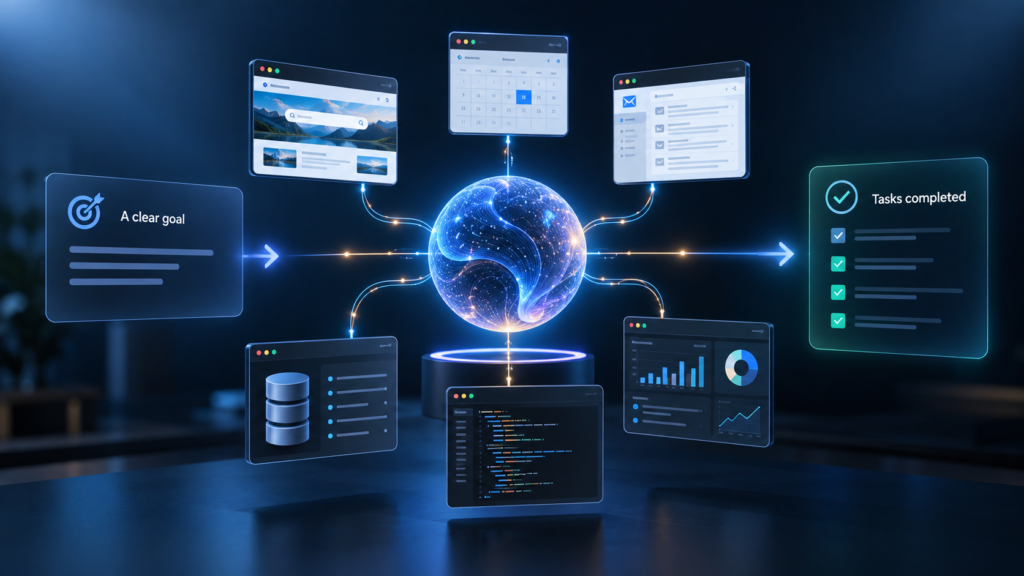
What Is an AI Agent? How AI Agents Work, Examples & Benefits
If you’ve spent any time around artificial intelligence lately, you’ve probably noticed a new phrase appearing everywhere: AI agents.
Chatbots have been around for years. So what’s different about an AI agent?
The simplest answer is this:
A chatbot mainly responds to you. An AI agent can take a goal and work through the steps needed to accomplish it.
That might mean researching information, using software tools, checking a database, writing and running code, organizing information, or taking an action in another application.
The important word is action.
Modern AI agents combine a capable AI model with tools, instructions and some degree of autonomy. Instead of waiting for a human to tell them every individual step, they can decide what to do next, observe the result and adjust their approach.
That doesn’t mean they’re independent digital employees that can safely do anything on their own. Good agents still operate within permissions, rules and human oversight.
But the shift from “answer my question” to “get this done” is significant.
What is an AI agent?
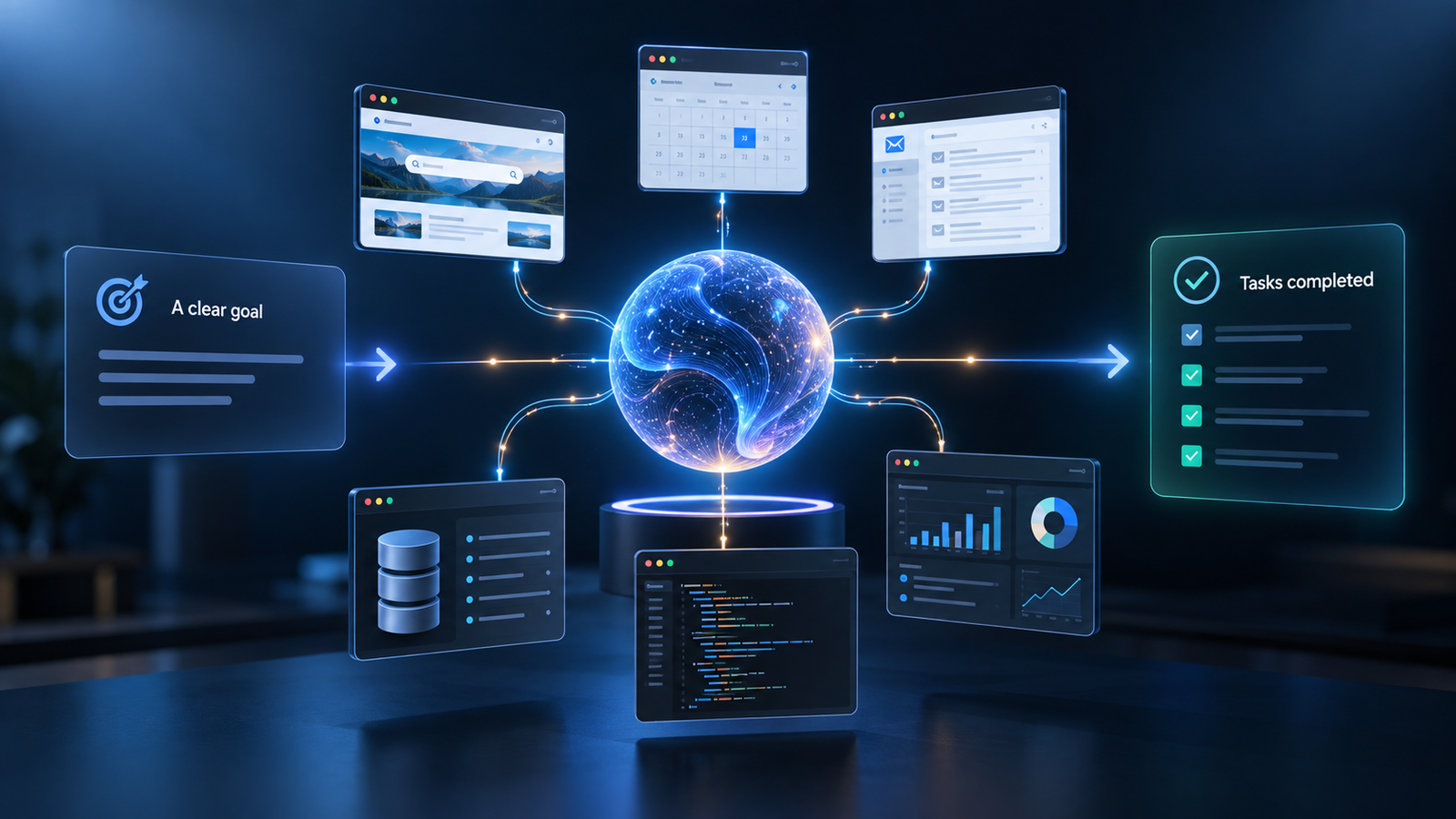
An AI agent is a software system that uses artificial intelligence to pursue a goal, make decisions, use tools and take actions with a degree of independence.
A typical agent combines several pieces:
- An AI model to understand instructions and reason about what to do
- Tools that let it interact with websites, software, databases, APIs or other systems
- Memory or state to keep track of relevant information during a task
- Instructions and guardrails that define what it is allowed to do
- An execution loop that allows it to act, observe the result and decide what to do next
OpenAI describes agents as systems that independently accomplish tasks on a user’s behalf, while Anthropic draws a distinction between fixed workflows and agents that dynamically decide their own process and tool use.
That distinction is useful because not everything marketed as an “AI agent” is truly autonomous.
Some products are essentially sophisticated automated workflows. Others can genuinely choose their next actions based on what they encounter.
For current consumer tools, trust, and everyday examples (Meta Muse, Gemini in Chrome, and more), see our practical guide: AI Agents Explained: What Can an AI Actually Do for You Now?.
The industry is still developing common terminology, so you’ll see the word agent used somewhat differently from one product to another.
How do AI agents work?
Think about asking a human assistant:
“Find me three good hotels in London for next weekend, compare the prices and tell me which one you’d choose.”
A conventional software program might require you to specify exactly where to search, what dates to enter, how to compare the results and what information to return.
An AI agent can potentially handle much of that process itself.
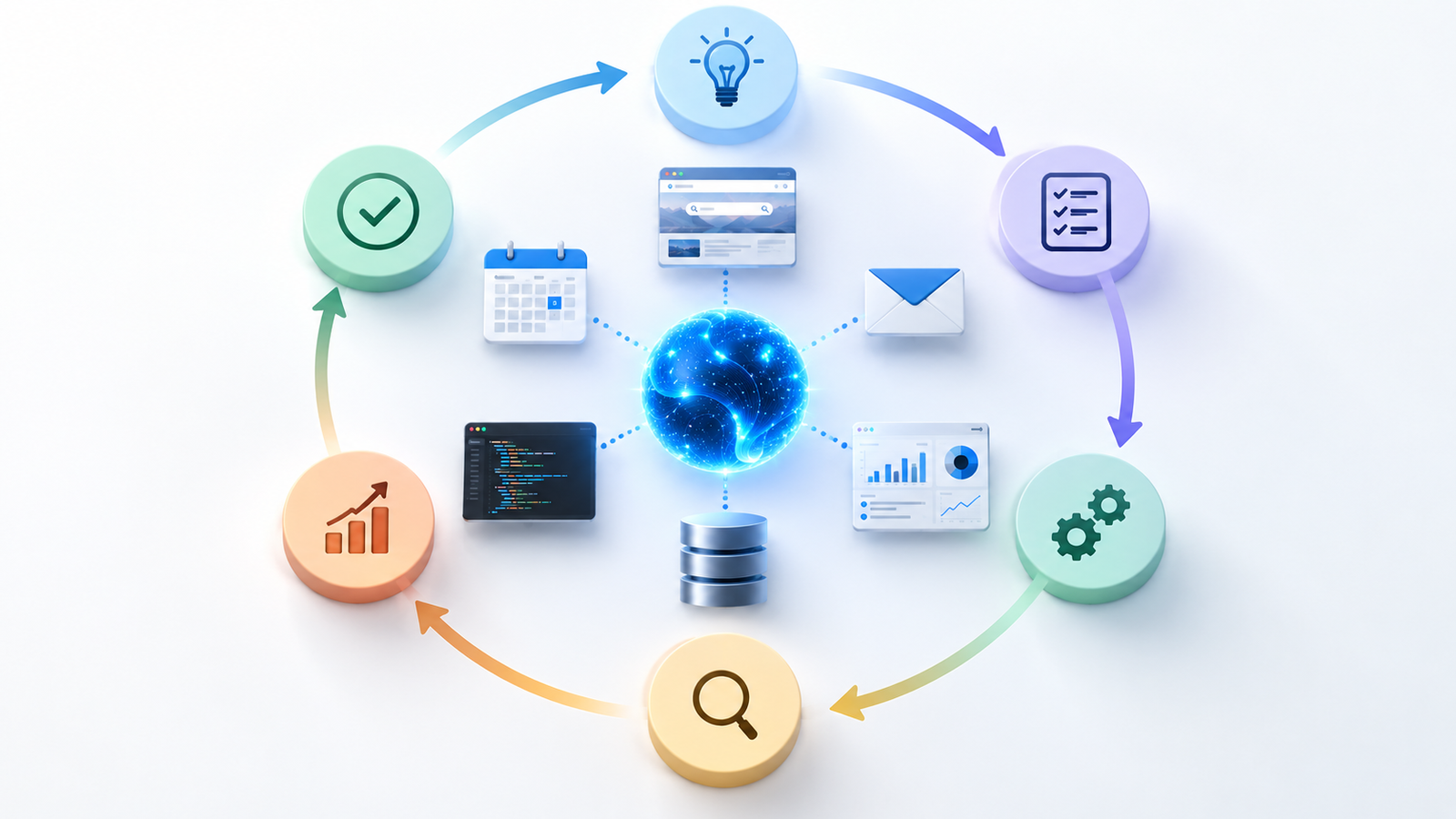
A simplified agent loop looks like this:
Goal → Plan → Act → Observe → Adjust → Act again → Complete
For example:
- Understand the goal — The agent interprets what you actually want.
- Break the goal into steps — It determines what information or actions are needed.
- Choose a tool — It might use a search engine, database, API, browser or another application.
- Take an action — It gathers information or performs an operation.
- Check the result — It looks at what happened rather than blindly continuing.
- Adjust its plan — If something didn’t work, it can try another approach.
- Finish or ask for help — Once the task is complete—or it reaches a point requiring human approval—it stops.
This ability to operate in a loop is one of the characteristics that separates an agent from a simple one-shot AI response.
AI agent vs. chatbot: What’s the difference?
This is probably the easiest way to understand the idea.
Imagine asking a chatbot:
“How can I improve my company’s customer support?”
A chatbot might give you a list of recommendations.
An AI agent could potentially be given a much broader assignment:
“Analyze our recent customer-support conversations, identify the most common complaints, summarize them and create a report for the support team.”
The agent could retrieve the relevant information, analyze it, organize its findings and produce the report using connected tools.
The difference isn’t simply that one is “smarter.”
It’s about what the system is able and permitted to do after receiving the instruction.
| Traditional chatbot | AI agent |
|---|---|
| Primarily responds to prompts | Works toward a goal |
| Usually produces an answer | Can perform multiple steps |
| Limited tool interaction | Can use connected tools |
| Often follows a conversation | Can execute a task |
| Human provides the next instruction | Agent may determine the next step |
| Usually ends after responding | Can continue until a stopping condition |
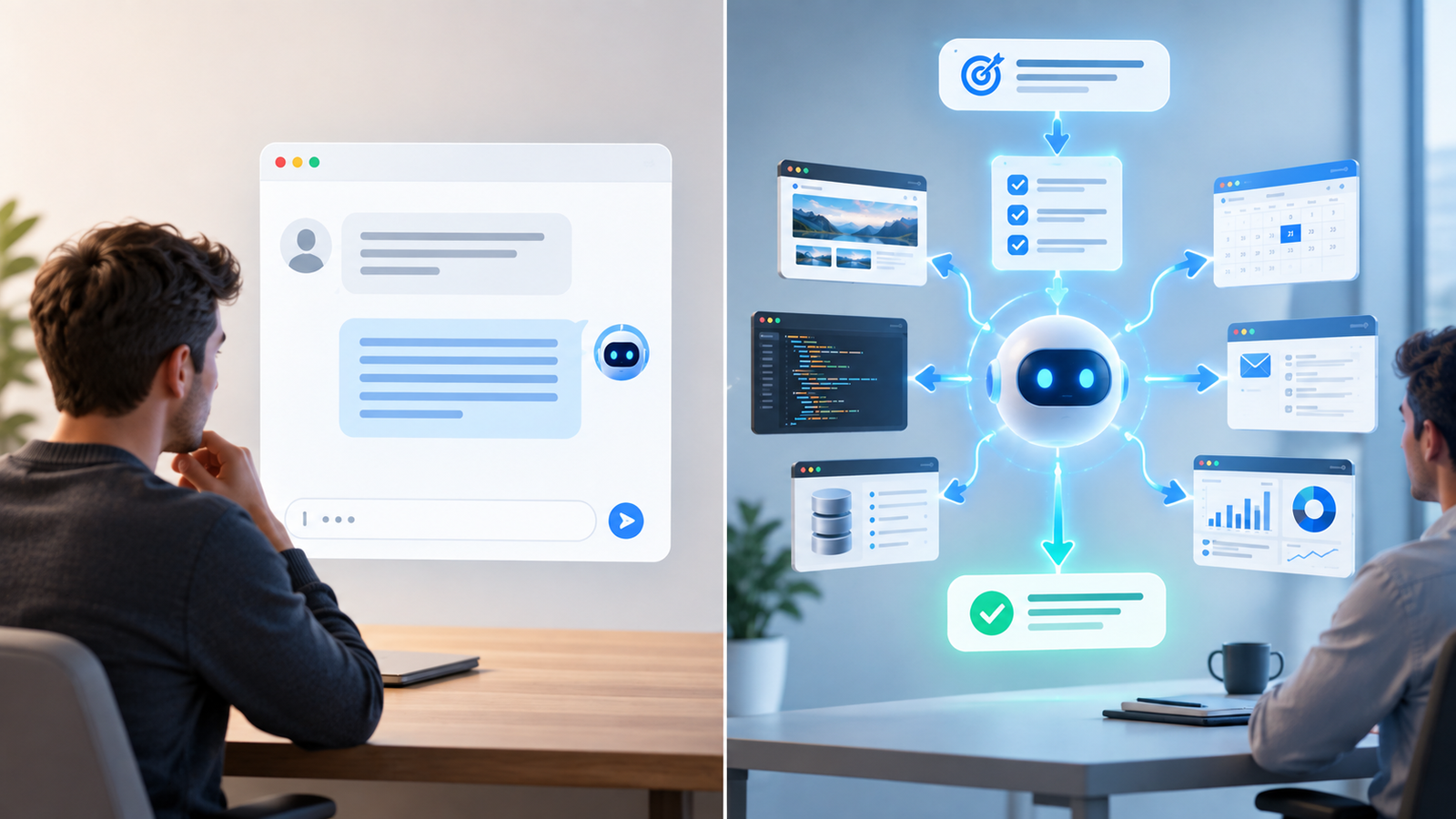
A chatbot can also have tools, memory and sophisticated capabilities. So this isn’t a perfectly clean dividing line. The important difference is whether the AI is actually directing the work and taking actions toward a goal.
What can AI agents do?
The possibilities depend heavily on the tools and permissions an agent has.
Some practical examples include:
Research
An agent could search multiple sources, collect relevant information, compare findings and prepare a report.
Customer service
Instead of simply answering a customer’s question, an agent could potentially look up an order, check a company’s policies, initiate an approved process and update the customer.
Software development
Coding agents can inspect a codebase, identify problems, edit files, run tests and iterate on their work.
Data analysis
An agent could retrieve data, analyze it, create calculations and produce a report or visualization.
Personal productivity
An agent might organize information from different applications, prepare documents, summarize meetings or handle repetitive administrative work.
Business operations
Companies can use agents to work across internal systems—for example, helping with support, sales operations, research or routine back-office processes.
The common thread is that the AI isn’t just generating text. It is connected to systems that allow it to do something with that information.
A simple real-world example of an AI agent
Imagine a company receives hundreds of customer emails every day.
A basic AI system might classify each email:
“This is a refund request.”
An agent could potentially go further:
Email arrives → understand request → find customer record → check order → check refund policy → determine next step → prepare response → request approval if required → update the system
That’s an agentic workflow.
Notice that the AI still shouldn’t necessarily be allowed to issue refunds without limits. A well-designed system could require a human to approve certain actions.
That’s where guardrails become important.
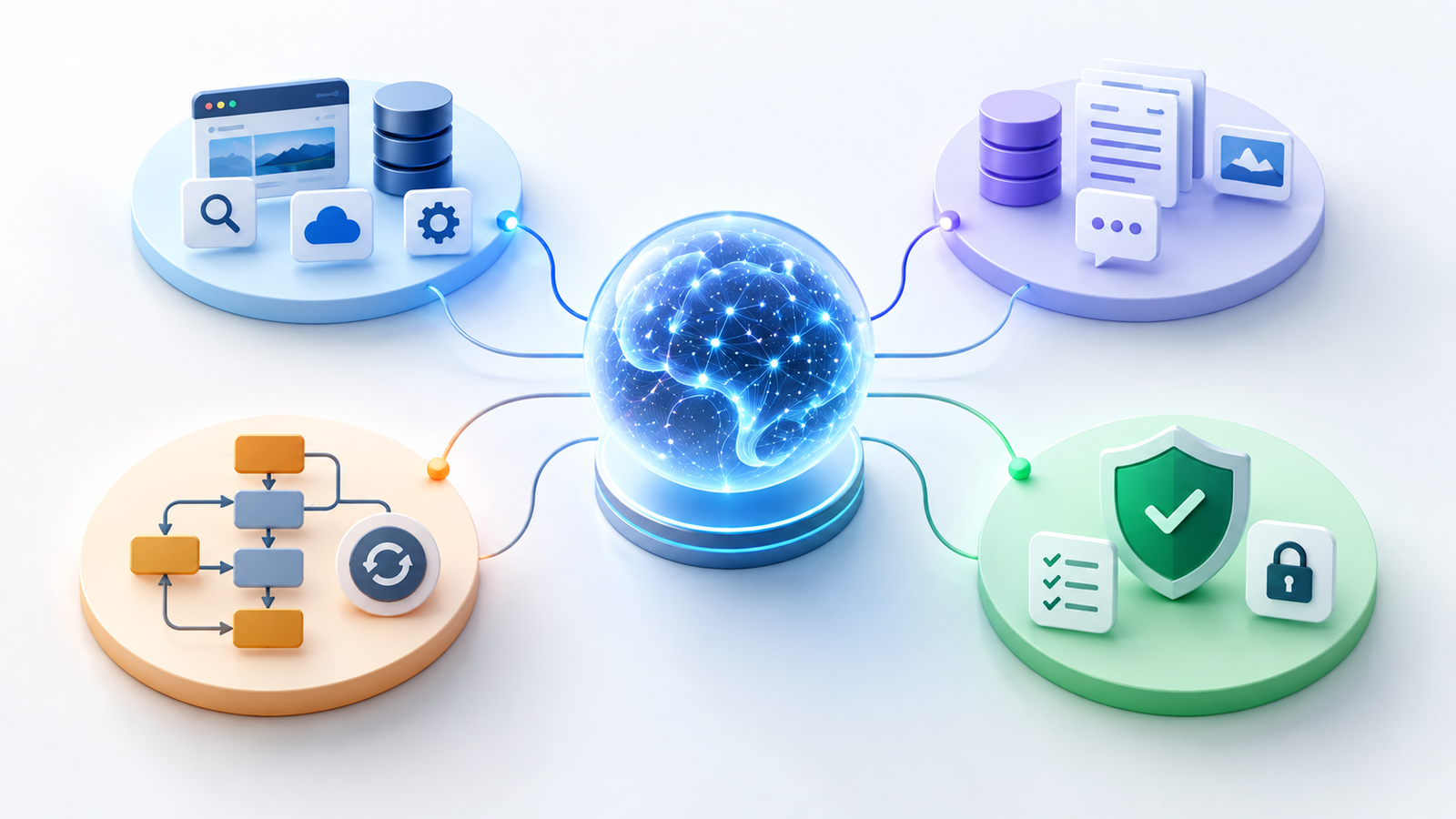
What are the main components of an AI agent?
Although implementations vary, most agent systems can be understood through a few basic components.
1. The AI model
This is the reasoning engine.
A large language model or another AI model interprets the user’s request, considers available information and decides what should happen next.
2. Tools
Tools give the agent ways to interact with the outside world.
These might include:
- Web search
- APIs
- Databases
- Code execution
- Calendar systems
- Business software
- File storage
- Browsers
Without useful tools, an agent’s ability to take real-world action is limited.
3. Memory and context
Agents often need to remember what has already happened during a task.
For example, an agent researching a company needs to keep track of what it has already searched so it doesn’t repeatedly perform the same work.
Some systems can also use longer-term information, depending on their design.
4. Orchestration
This is the layer that coordinates the model, tools, information and actions.
It determines how the different pieces interact during a task. Google describes orchestration as managing things such as memory, state, decision-making, planning and tool usage.
5. Guardrails
This part is easy to overlook—and arguably one of the most important.
Guardrails define what an agent can and cannot do.
For example, an agent might be allowed to draft an email but require human approval before sending it.
The more consequential the action, the more important appropriate permissions and human oversight become.
Are AI agents fully autonomous?
Usually, no—and that’s an important distinction.
“Autonomous” doesn’t mean an AI has unlimited freedom.
An agent can be autonomous within a defined environment.
For example, an agent might be allowed to:
- Search the web
- Read certain files
- Analyze information
- Create a draft
But it might not be allowed to:
- Spend money
- Delete data
- Send external communications
- Change important settings
without asking a human first.
This is why trustworthy agent design is as much about control and permissions as it is about intelligence.
Anthropic has highlighted risks including compounding errors and the need for testing and guardrails as agents become more capable and operate for longer periods.
What are the benefits of AI agents?
The biggest advantage is not simply that an agent can produce an impressive answer.
It’s that an agent can potentially take work off a person’s plate.
For businesses, that could mean:
Less repetitive work — Employees spend less time moving information between systems or performing routine tasks.
More scalable operations — A company can potentially handle more work without increasing every manual process at the same rate.
Faster execution — Tasks that require several software interactions can happen much more quickly.
More flexible automation — Traditional automation usually follows predefined rules. Agents can be useful when the exact sequence of steps changes from one situation to another.
Anthropic makes this distinction particularly well: fixed workflows are useful when the process is predictable, while agents become more attractive when the path to the answer or outcome cannot easily be hard-coded in advance.
What are the risks of AI agents?
The same autonomy that makes agents useful also creates new risks.
An AI that can only generate text can produce a bad answer.
An AI that can take actions can potentially cause a much bigger problem.
Possible issues include:
- Incorrect decisions
- Hallucinated information
- Poor tool use
- Security vulnerabilities
- Privacy problems
- Unintended actions
- Excessive spending or resource use
- Errors that compound over multiple steps
That’s why agent systems need testing, monitoring, appropriate permissions and clear stopping conditions.
A good rule is simple:
The more an AI can do, the more carefully its access should be controlled.
Are AI agents the future of AI?
They may be one of the most important directions in AI development.
The broader shift is easy to see.
Early AI applications largely focused on prediction.
Then generative AI made it possible for computers to produce text, images, audio, video and code.
AI assistants made those capabilities conversational.
Agents take another step:
AI that can use those capabilities to pursue a goal and actually do the work.
But that doesn’t mean every task needs an agent.
Sometimes a simple prompt is better. Sometimes a traditional software workflow is safer and more reliable. Anthropic recommends starting with the simplest approach that solves the problem and adding agentic complexity only when it provides a meaningful benefit.
That’s an important point that can get lost in all the hype.
The goal isn’t to make everything agentic. The goal is to make useful work easier.
The simplest way to think about an AI agent
If you’re still wondering what an AI agent actually is, remember this:
A chatbot gives you an answer.
An AI assistant helps you with a task.
An AI agent can potentially take a goal, figure out the steps, use tools, act on your behalf and adjust its approach until the task is finished—or until it needs you to step in.
That’s why AI agents are attracting so much attention.
The technology is still evolving, and the boundaries between assistants, workflows and agents aren’t always clear. But the direction is unmistakable: AI is moving from systems that simply generate things toward systems that can increasingly do things.
And that could have a much bigger impact on how we work than another chatbot ever could.
FAQ
What is an AI agent in simple terms?
An AI agent is an AI-powered system that can pursue a goal by planning steps, using tools and taking actions with some degree of independence.
Is ChatGPT an AI agent?
ChatGPT can function as an agent in contexts where it is given the ability to plan, use tools and take actions. However, a basic chatbot interaction by itself is not necessarily an AI agent.
What is the difference between AI and an AI agent?
AI is the broader technology. An AI agent is a system built using AI that can use its capabilities to pursue a goal, make decisions and take actions.
Can AI agents replace human workers?
AI agents can automate parts of many jobs, particularly repetitive digital tasks. But whether they can replace an entire role depends on the work involved, the reliability required and how much human judgment is needed.
Are AI agents safe?
They can be designed to operate safely, but they aren’t automatically safe. Agents need appropriate permissions, testing, monitoring and guardrails—particularly when they can affect external systems or make consequential decisions.
Also explore on CeoofInternet: What Is Artificial Intelligence?, What Is Generative AI?, and Learn AI.
