
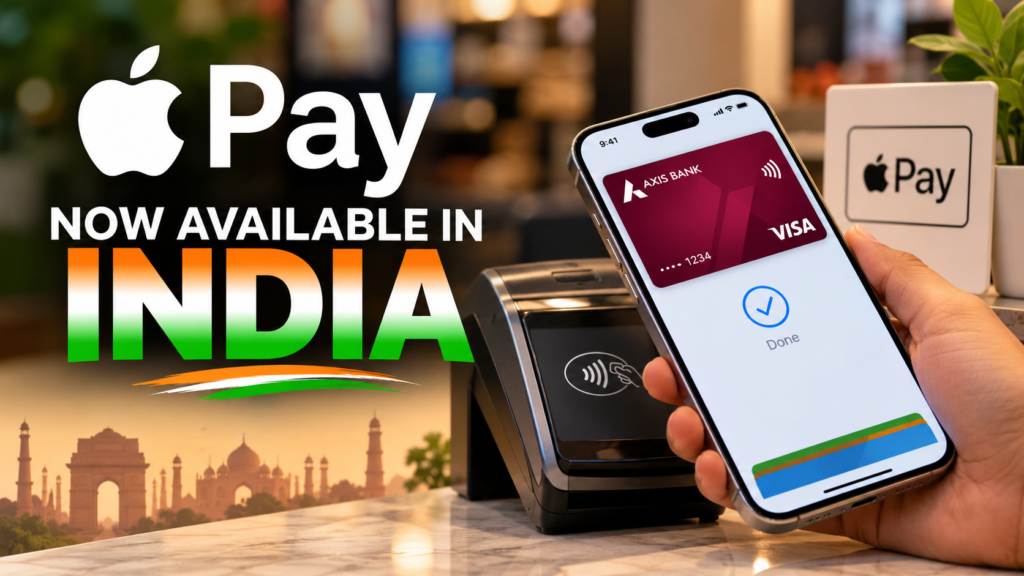
Apple Pay Is Finally Available in India: Everything You Need to Know
After years of waiting, Apple Pay has officially arrived in India.
Apple launched its contactless payment service in India on September 30, 2026, initially in partnership with Axis Bank. The rollout allows eligible Axis Bank credit card users on the Visa and Mastercard networks to add their cards to Apple Wallet and use Apple devices to make payments.
For Indian iPhone users, this is a significant development. However, Apple Pay’s arrival does not mean that it is replacing UPI or that every Indian bank card can suddenly be added to Apple Wallet.
The initial launch is deliberately limited, with more banks and cards expected to be added over time.
So, what exactly is Apple Pay, who can use it in India, how does it work, and how is it different from UPI?
Here’s everything you need to know.
Apple Pay has officially launched in India
Apple Pay is now available in India after launching in several other major markets around the world.
At launch, Axis Bank is the first Indian banking partner. Eligible Axis Bank credit cards running on the Visa and Mastercard networks can be added to Apple Wallet and used through Apple Pay.
Axis Bank confirmed that its Mastercard and Visa credit card customers can add their cards either through the Axis Bank mobile banking app or directly through Apple Wallet.
The service can be used for payments at participating merchants in stores, inside supported apps and on websites. Apple Pay is initially supported across iPhone, Apple Watch and iPad, while Mac support is expected to follow.
The launch does not currently include RuPay cards.
That means an Axis Bank customer with an eligible Visa or Mastercard credit card can use Apple Pay, while simply having an Axis Bank card does not automatically mean every card is supported.
Why Apple’s India launch is a big deal
Apple Pay first debuted in the United States in 2014. Its arrival in India therefore comes roughly 12 years after its original launch.
India is also a very different payments market from the United States.
The country’s digital-payment ecosystem is dominated by UPI, where users can transfer money directly from their bank accounts using apps such as Google Pay, PhonePe, Paytm and BHIM.
Apple Pay works differently.
Instead of replacing the bank account-to-bank-account payment model used by UPI, Apple Pay essentially turns an eligible credit or debit card into a digital payment credential that can be securely stored and used through an Apple device.
This distinction is important.
Apple Pay’s initial Indian rollout is therefore more about bringing Apple’s established card-payment experience to Indian users than replacing India’s UPI infrastructure.
Which Indian banks support Apple Pay?
At the time of launch, Axis Bank is the first Indian bank to officially support Apple Pay.
Initially, eligible:
- Axis Bank Visa credit cards
- Axis Bank Mastercard credit cards
can be added to Apple Wallet.
RuPay cards are not supported at launch.
Apple is expected to expand support to additional banks and card networks over time, but users should check directly with their bank before assuming that a particular card is eligible.
Discussions involving other major Indian banks have previously been reported, but those banks should not be considered supported until Apple and the respective issuer officially confirm their participation.
Which devices can use Apple Pay in India?
Apple Pay is designed to work across Apple’s ecosystem rather than being limited to the iPhone.
The Indian launch supports Apple Pay on compatible:
- iPhone models
- Apple Watch models
- iPad models
Apple has also indicated that Mac support is coming.
For the initial Indian rollout, reports indicate that compatible iPhones starting from the iPhone XR generation and running iOS 18 or later are supported, while Apple Watch support starts with Series 6 and later on compatible software.
However, device compatibility alone isn’t enough.
You also need an eligible card from a participating bank.
How to set up Apple Pay in India
Setting up Apple Pay is relatively straightforward if you have an eligible Axis Bank card.
Step 1: Open Apple Wallet
Open the Wallet app on your compatible iPhone.
Tap the “+” button to add a new card.
Step 2: Add your Axis Bank card
You can add an eligible Axis Bank Visa or Mastercard credit card directly through Apple Wallet.
Axis Bank also allows customers to add eligible cards through its mobile banking application.
Step 3: Complete verification
Your bank may require additional verification before the card can be activated for Apple Pay.
Once the verification process is completed, the card becomes available for use through Apple Wallet.
Step 4: Start paying
At a compatible contactless payment terminal, authenticate yourself using Face ID, Touch ID or your device passcode and hold the iPhone or Apple Watch near the payment terminal.
The payment can then be processed without physically handing over your card.
How do you pay using Apple Pay?
The experience is designed to be quick.
On an iPhone with Face ID, you generally double-click the side button and authenticate using Face ID or your passcode.
Then hold the top portion of the iPhone near a contactless payment terminal.
With Apple Watch, users can double-click the side button and hold the watch near the contactless reader.
The important difference is that you don’t have to open a separate payment app every time you want to make a contactless card payment.
Do you need to enter a card PIN?
Apple Pay is designed around device-based authentication.
Instead of repeatedly entering your physical card details, Apple Pay uses authentication such as:
- Face ID
- Touch ID
- Device passcode
for authorization.
For supported transactions, the user can therefore authenticate the payment on the Apple device rather than entering the physical card PIN or manually entering card information.
The exact payment and verification experience can still depend on the merchant, card issuer and transaction.
Where can Apple Pay be used in India?
Apple Pay can be used wherever the service is supported by the merchant and payment infrastructure.
This includes three major categories:
1. Physical stores
You can use Apple Pay at compatible contactless payment terminals.
Look for the contactless payment symbol or Apple Pay acceptance at checkout.
2. Apps
Apple Pay can be integrated into supported iPhone and iPad applications.
Instead of entering card information manually, customers can select Apple Pay and authenticate the transaction on their device.
3. Websites
Apple Pay can also be offered as a payment option on supported websites.
Payment processors such as PayU have already built Apple Pay integration for Indian merchants, allowing eligible businesses to offer Apple Pay through their checkout infrastructure.
This means the service isn’t limited to physical tap-to-pay transactions.
Apple Pay vs UPI: What’s the difference?
This is probably the most important question for Indian users.
Apple Pay and UPI are both digital payment technologies, but they work differently.
| Feature | Apple Pay | UPI |
|---|---|---|
| Primary payment source | Eligible debit/credit card | Bank account |
| QR payments | Not its primary model | Yes |
| Tap-to-pay | Yes | Supported in certain implementations |
| Card details at checkout | Tokenized | Usually not required |
| Authentication | Face ID, Touch ID or passcode | UPI PIN/other supported authentication |
| Bank support | Individual card issuers must support Apple Pay | Broad ecosystem of participating banks |
| Typical apps | Apple Wallet / supported merchant apps | Google Pay, PhonePe, Paytm, BHIM and others |
| International use | Depends on card/merchant/country | Primarily India’s UPI ecosystem, with expanding international acceptance |
In simple terms:
UPI moves money directly from your bank account. Apple Pay lets you use an eligible payment card through your Apple device.
That means the two services can coexist.
An iPhone user could continue using UPI for QR payments while using Apple Pay for eligible card transactions.
Does Apple Pay replace Google Pay or PhonePe?
No.
Apple Pay isn’t simply another version of Google Pay or PhonePe’s Indian UPI experience.
Google Pay and PhonePe are heavily integrated into India’s UPI ecosystem, allowing users to make bank-to-bank payments, scan QR codes, transfer money and pay bills.
Apple Pay’s initial Indian offering is much more focused on card payments.
For example, someone could use a UPI app to scan a shop’s QR code and pay directly from a bank account, while using Apple Pay to tap an iPhone or Apple Watch on a compatible card terminal using an eligible Axis Bank credit card.
So, rather than looking at Apple Pay as a direct replacement for UPI apps, it makes more sense to see it as another payment option within India’s increasingly diverse digital-payment ecosystem.
Is Apple Pay safe?
Security and privacy are central parts of Apple’s Apple Pay design.
Apple says that when a card is added to Apple Pay, the actual card number isn’t simply stored on Apple’s servers or shared with merchants.
Instead, Apple Pay uses a device-specific account number and a unique transaction security code.
This means the merchant does not receive the user’s actual physical card number during an Apple Pay transaction.
Apple also uses the device’s security system to authorize payments.
Depending on the device, this can involve Face ID, Touch ID or a passcode.
The basic idea is that even if someone gets access to the payment terminal, they don’t simply receive the customer’s physical card details in the same way as a traditional card transaction.
What happens if you lose your iPhone?
Losing a phone containing payment cards may sound alarming, but Apple provides mechanisms to protect Apple Pay.
Apple’s device security means that a person cannot simply pick up a locked iPhone and start making Apple Pay purchases without authentication.
If an iPhone is lost, users can also use Apple’s Find My system to mark the device as lost and take steps to protect it.
This is one reason why Apple Pay is fundamentally different from simply storing a photograph or copy of your physical card on a smartphone.
Will Apple Pay work without an internet connection?
For contactless payments, Apple Pay does not necessarily require you to have an active internet connection at the exact moment you tap your device at a compatible terminal.
The payment credentials are stored securely on the device and the transaction is processed through the payment network and merchant infrastructure.
However, specific circumstances can affect whether a transaction succeeds, including the card issuer, terminal, merchant infrastructure and other payment-system requirements.
So users should not think of Apple Pay as a completely independent offline payment system.
What about RuPay cards?
This is one of the biggest limitations of the initial launch.
RuPay cards are not supported at launch.
This is particularly significant in India because RuPay is the country’s domestic card network and is widely used.
Apple Pay’s initial rollout therefore covers only a portion of the Indian card market.
The service will become more broadly useful if Apple and additional banks and card networks expand support in the future.
What about HDFC Bank, ICICI Bank and SBI Cards?
At launch, these banks should not be treated as Apple Pay-supported issuers simply because they are major Indian card providers.
Apple Pay’s initial Indian partnership is with Axis Bank.
Reports have indicated that Apple has held discussions with other major card issuers, including HDFC Bank and ICICI Bank, but commercial agreements have not yet been finalized for the initial rollout.
Update (October 1, 2026): According to Moneycontrol, the sticking point is the fee. Apple is reportedly seeking a commission of about 0.20% on each Apple Pay transaction, while the larger issuers have been willing to offer around 0.15%. Until that gap closes, HDFC Bank, ICICI Bank and SBI Card customers may have to wait.
This could change as Apple Pay expands in India.
For now, the safest approach is to check Apple’s official support information or the card issuer’s own announcement before attempting to add a card.
Which merchants are accepting Apple Pay?
Acceptance will depend on whether the merchant and its payment infrastructure support Apple Pay.
The launch is expected to cover a range of online and offline merchants, while payment providers such as PayU are enabling Indian businesses to integrate Apple Pay into their checkout systems.
At launch, Apple named merchants including Apple Store locations, Blinkit, Chaayos, Comet, Croma, Interflora, Ixigo, Le15 Patisserie, Reliance brands, Tata 1mg and Zomato among those accepting Apple Pay, though availability can still vary from merchant to merchant.
In physical stores, the simplest indicator is whether the payment terminal supports compatible contactless transactions.
For online purchases, the Apple Pay button may appear at checkout when the merchant and device are eligible.
Why Apple Pay could be interesting for Indian iPhone users
India has become one of Apple’s important growth markets, and the company has been expanding its presence across the country.
Apple Pay gives the company another way to make the iPhone more useful as a payment device.
For users who already have an eligible credit card, the appeal is relatively straightforward.
Instead of taking out the physical card, entering card details online or manually entering information at checkout, the payment credential can be stored in Apple Wallet and authenticated directly through the Apple device.
For Apple Watch users, the experience can be even more convenient because a payment can be authorized directly from the wrist.
But Apple Pay has one major challenge in India
India already has an extremely mature digital-payment ecosystem.
UPI has made QR-code payments and instant bank transfers part of everyday life for millions of Indians.
A small shop may not have a traditional card terminal but may have a UPI QR code sitting on the counter.
That’s where Apple Pay’s initial card-focused model faces a practical limitation.
Apple Pay works particularly well when a merchant supports contactless card payments or offers Apple Pay at online checkout.
UPI, meanwhile, is deeply embedded in India’s bank-account payment infrastructure.
This means Apple Pay isn’t entering an empty market.
It’s entering one of the world’s most developed digital-payment environments.
Why the launch still matters
Even with its limited initial bank and card support, Apple Pay’s arrival is important for several reasons.
First, it gives Indian iPhone and Apple Watch users a native Apple payment experience.
Second, it creates another option for people who prefer using credit cards for rewards, cashback, travel points or other card benefits.
Third, Apple’s entry could encourage more banks, payment processors and merchants to support the platform.
And finally, it signals that Apple sees India’s growing digital economy as important enough to bring one of its major financial services to the country after years of absence.
What happens next?
The biggest question is how quickly Apple Pay expands beyond its initial Axis Bank partnership.
More banks would significantly increase the usefulness of the service.
Support for additional card networks, particularly RuPay, could also broaden its potential user base.
Merchant acceptance will be another important factor.
If more Indian websites, apps and physical stores add Apple Pay, the service could become a regular part of the payment choices available to iPhone users.
Apple’s partnership with Axis Bank is therefore better viewed as the beginning of its Indian Apple Pay rollout rather than the final form of the service.
The bottom line
Apple Pay is finally available in India, but its launch is more limited than the headline might suggest.
As of the September 30, 2026 launch:
- Axis Bank is the first Indian banking partner.
- Eligible Axis Bank Visa and Mastercard credit cards are supported.
- RuPay cards are not supported at launch.
- iPhone, Apple Watch and iPad are supported.
- Mac support is coming.
- Payments can be made in participating stores, apps and online.
- Authentication uses Apple’s device security, including Face ID, Touch ID or a passcode.
- Apple Pay is fundamentally different from UPI because it is initially a card-based payment system rather than a direct bank-account transfer system.
For Indian iPhone users with an eligible Axis Bank card, Apple Pay finally provides the native Apple payment experience many have been waiting for.
But whether it becomes a major part of India’s payment landscape will depend largely on what happens next: more banks, more cards, more merchants and broader payment-network support.
For now, Apple Pay has officially entered India — but this is only the first chapter.
