
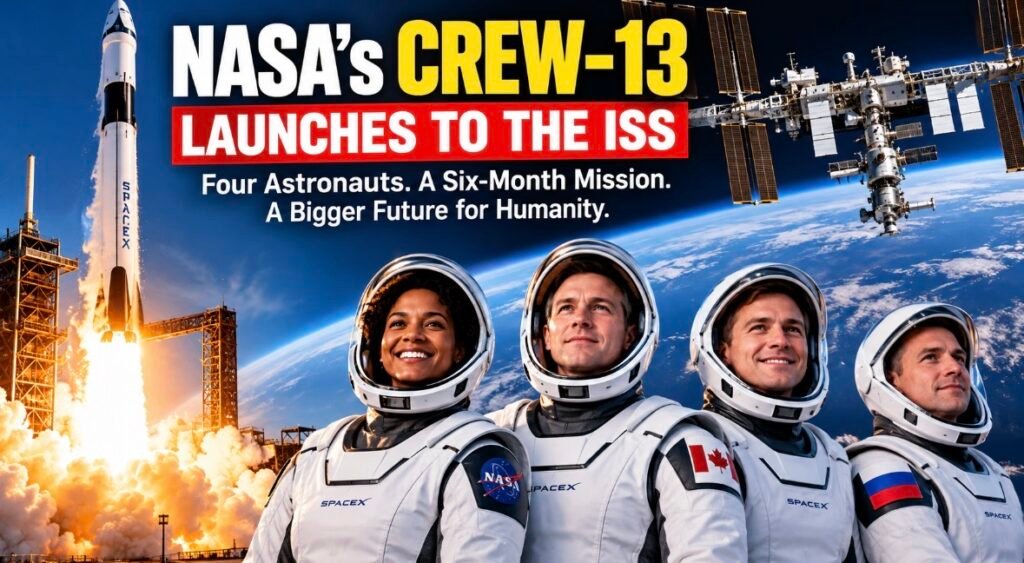
NASA’s Crew-13 Launches to the ISS: Four Astronauts Begin a Six-Month Mission in Space
October 1, 2026
Space once again became the destination for four people on Thursday as a SpaceX Falcon 9 lifted off from Florida carrying NASA’s Crew-13 astronauts toward the International Space Station (ISS).
The launch took place at 11:10 a.m. EDT on October 1, 2026, from Space Launch Complex 40 at Cape Canaveral Space Force Station.
On board the Dragon spacecraft were NASA astronauts Jessica Watkins and Luke Delaney, Canadian astronaut Joshua Kutryk, and Russian cosmonaut Sergey Teteryatnikov.
For the crew, the launch marks the beginning of a mission lasting roughly six months. But Crew-13 is about much more than simply getting four people to the ISS. The astronauts will conduct scientific research, test technologies, study how the human body reacts to long periods in space, and help prepare for missions that could eventually take humans back to the Moon and, one day, to Mars.
A fast trip to the space station
One of the interesting aspects of Crew-13 is how quickly the astronauts are expected to reach the ISS.
NASA planned an approximately 7-hour, 50-minute journey from launch to docking, which NASA described as the fastest trip by a U.S. spacecraft to the space station. The Dragon spacecraft was scheduled to dock with the space-facing port of the station’s Harmony module.
That may sound like a long time compared with a commercial airline flight, but space travel is very different.
The Dragon doesn’t simply fly straight toward the ISS. After reaching orbit, it performs a series of carefully calculated orbital maneuvers, gradually changing its position and trajectory until it can rendezvous with the station.
The spacecraft can dock autonomously, while the astronauts remain capable of taking manual control if necessary.
Meet the four astronauts of Crew-13
The Crew-13 team brings together astronauts from three different space agencies.
Jessica Watkins — NASA Commander
Jessica Watkins is the commander of Crew-13 and is returning to the ISS for her second spaceflight.
Watkins has a background in geology and planetary science. She earned her undergraduate degree at Stanford University and a doctorate in geology from UCLA. Before becoming an astronaut, she worked on research related to Mars and was part of the science team associated with NASA’s Curiosity rover.
She previously spent 170 days in space during NASA’s SpaceX Crew-4 mission in 2022.
Crew-13 is also notable because Watkins becomes the first NASA astronaut to launch twice aboard a SpaceX Dragon spacecraft.
Her role on this mission is especially significant because she isn’t simply returning to space as a crew member. She is leading the mission.
Luke Delaney — NASA Pilot
Luke Delaney is the pilot of Crew-13 and is making his first trip into space.
Before becoming a NASA astronaut, Delaney was a naval aviator and test pilot. His education includes mechanical engineering and aerospace engineering, and he later worked as a research pilot at NASA’s Langley Research Center.
That combination of aviation, engineering and flight-test experience is particularly relevant to his role aboard Dragon.
Joshua Kutryk — Canadian Space Agency
Joshua Kutryk is representing the Canadian Space Agency and is also making his first trip to space.
Kutryk previously served as a CF-18 fighter pilot and later worked as an experimental and operational test pilot.
His academic background is equally extensive, including mechanical engineering, space studies, flight-test engineering and defense studies.
Sergey Teteryatnikov — Roscosmos
Sergey Teteryatnikov is the fourth member of the crew and represents Russia’s Roscosmos space agency.
He trained as an engineer specializing in ship power-plant operations and previously served in Russian naval engineering roles, including work involving underwater vessels.
Like Delaney and Kutryk, this is his first spaceflight.
Crew-13 is really a science mission
It is easy to think of an ISS crew rotation as simply replacing one group of astronauts with another.
In reality, the station is a giant laboratory.
Crew-13 will conduct experiments involving human health, biology, agriculture, technology and spacecraft operations. NASA says the work is intended not only to expand scientific knowledge but also to support future human missions farther from Earth.
One area getting particular attention is the human body.
Living in microgravity for months changes the way the body works. Astronauts can experience changes involving circulation, vision, muscles, bones, balance and cardiovascular function.
Crew-13 will contribute to several investigations designed to better understand these changes.
What happens to the human body in space?
This is one of the biggest challenges facing future Moon and Mars missions.
On Earth, gravity is constantly pulling blood toward the lower part of the body. In microgravity, that normal distribution changes. Long-duration spaceflight can also affect the cardiovascular system and other physiological processes.
Crew-13 will participate in research examining blood flow and blood clotting, with researchers hoping the findings could eventually improve our understanding and treatment of blood-clot risks both in space and on Earth.
The astronauts will also participate in research concerning Spaceflight-Associated Neuro-ocular Syndrome, or SANS.
SANS can cause changes to astronauts’ eyes during long-duration missions. NASA is studying whether daily B-vitamin supplementation can help reduce or prevent these effects. Crew members participating in the study will undergo vision testing before, during and after their mission.
Can astronauts still land a spacecraft after months in space?
Another fascinating experiment involves something that sounds almost like a video game—but has serious implications for future missions.
Crew-13 astronauts will perform lunar-landing simulations as part of research into manual piloting performance.
Why?
Because landing on the Moon or Mars is not the same as docking with the ISS.
Astronauts returning from a long period in microgravity may experience changes in their sensory systems, orientation and ability to control motion. Researchers want to understand whether these changes could affect their performance during demanding landing operations.
The study will also investigate whether refresher training shortly before landing can improve astronauts’ performance and decision-making.
This could become increasingly important as NASA prepares for missions in which astronauts will spend much longer away from Earth.
Exercise becomes part of the job
Astronauts don’t exercise in space simply to stay fit.
Exercise is effectively a countermeasure against the effects of microgravity.
Crew-13 will contribute to research examining exercise routines and how they relate to astronaut health and performance.
One study, called Zero T2, compares data from astronauts who use the station’s treadmill for aerobic exercise with those who don’t. The objective is to help researchers develop exercise strategies for future missions where spacecraft size or mission design could limit access to large exercise equipment.
That becomes especially relevant when thinking about spacecraft traveling to Mars.
A vehicle traveling millions of kilometres from Earth cannot simply carry every piece of equipment that astronauts might use on the ISS.
The ISS is a stepping stone to the Moon and Mars
The International Space Station has been continuously occupied for more than 25 years.
Its importance today is not simply that humans can live in orbit.
The ISS gives scientists an environment where they can study what happens when people, machines, plants and biological systems operate away from Earth’s gravity for long periods.
NASA uses this knowledge as part of its broader preparation for future exploration, including Artemis missions to the Moon and eventual human missions to Mars.
A six-month stay on the ISS may therefore seem like a relatively small step compared with a Mars expedition.
But it provides something extremely valuable: real experience.
Before humans can safely spend months traveling through deep space, scientists need to understand what happens to the human body and how astronauts can continue making decisions, operating equipment and performing physically demanding tasks after spending extended periods in microgravity.
Dragon “Grace” returns to space
Crew-13 is flying aboard a SpaceX Dragon spacecraft named Grace.
Interestingly, this isn’t the spacecraft’s first trip to the ISS.
Grace previously flew during Axiom Mission 4 in 2025, making Crew-13 another example of spacecraft reuse in human spaceflight.
The Falcon 9 first stage supporting Crew-13 is also being reused. SpaceX says the booster previously launched Crew-12 and a Starlink mission, and is intended to land back at Cape Canaveral after stage separation.
This reusability is one of the defining features of modern commercial spaceflight.
Instead of treating every rocket and spacecraft as disposable hardware, companies such as SpaceX are increasingly designing vehicles to fly multiple times.
Four people, six months, and a very different workplace
There is another side to Crew-13 that is easy to overlook.
The ISS is not just a laboratory. It is also the astronauts’ home for months.
The crew will live, sleep, eat, exercise, conduct experiments and work together in an environment where there is no normal “outside.”
Everything has to be planned.
Food, water, oxygen, exercise, waste management, equipment maintenance and communication with Earth all become part of daily life.
And unlike most workplaces, getting home isn’t as simple as walking out the door.
That makes teamwork particularly important.
Crew-13 also represents the international nature of the ISS. American, Canadian and Russian astronauts are working together aboard the same orbital laboratory despite the complicated geopolitical relationship between their countries.
Spaceflight can be technically difficult enough without adding another layer of complexity. International cooperation is therefore itself an important part of keeping the station operating.
Why Crew-13 matters
Crew-13 isn’t the first crew to visit the ISS, and it won’t be the last.
But every crew adds another piece to humanity’s growing experience of living and working away from Earth.
The experiments conducted during this mission could help answer some surprisingly basic questions:
- How do we keep astronauts healthy for years rather than months?
- Can people still operate spacecraft effectively after long periods in microgravity?
- How should astronauts exercise during deep-space missions?
- How can we reduce the medical risks associated with prolonged spaceflight?
And ultimately:
Can humans safely live and work on another world?
Those questions are much bigger than Crew-13 itself.
But answering them starts with missions like this one.
The next chapter is already being written
As Crew-13 settles into life aboard the International Space Station, the spectacular launch will quickly become a memory for most people watching from Earth.
For the astronauts, however, the real mission has just begun.
Over the next several months, their days will be filled with experiments, maintenance, exercise, scientific observations and the ordinary routines of living in orbit.
Every measurement they collect and every experiment they complete adds to a much larger body of knowledge.
The Moon may be the next destination for humans beyond low Earth orbit.
Mars is farther away still.
But before humans can build a sustainable presence beyond Earth, they need to learn how to live away from it.
Crew-13 is another step in that process.
And for four astronauts orbiting hundreds of kilometres above Earth, the journey has only just begun.
FAQ
What is NASA Crew-13?
NASA Crew-13 is a crew rotation mission carrying four astronauts to the International Space Station aboard a SpaceX Dragon spacecraft.
Who are the Crew-13 astronauts?
Crew-13 includes NASA astronauts Jessica Watkins and Luke Delaney, Canadian astronaut Joshua Kutryk and Roscosmos cosmonaut Sergey Teteryatnikov.
How long will Crew-13 stay in space?
The Crew-13 astronauts are scheduled to spend approximately six months aboard the International Space Station.
What will Crew-13 do on the ISS?
The crew will conduct scientific experiments, maintain the space station and participate in research into human health and performance during long-duration spaceflight.
Why is Crew-13 important?
Research conducted during Crew-13 can contribute to NASA’s understanding of long-duration human spaceflight and help prepare astronauts for future missions to the Moon and Mars.
Follow the Crew-13 mission
For readers who want to follow the mission directly, these are the best places to start:
Sources: NASA, SpaceX, Associated Press and WESH 2. Information and mission status reflect the Crew-13 launch on October 1, 2026.
