
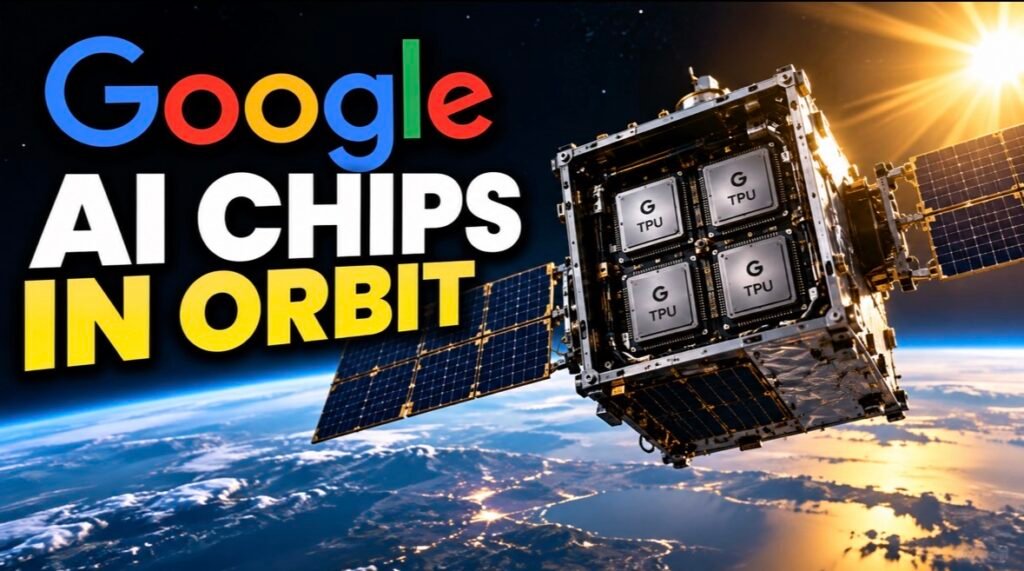
Google Just Put AI Chips in Orbit. Here’s What It’s Testing
Right now, a satellite about the size of a fridge is circling Earth with four of Google’s AI chips inside. For the next few weeks they have one job, and it’s a simple one: don’t break.
It’s the first real hardware test for Google Project Suncatcher, the company’s long-shot idea to run AI data centers in space, powered by the sun. Sounds like sci-fi. This part, at least, is real.
What Google Project Suncatcher just launched
On October 1, Google’s Project Suncatcher prototype launched on SpaceX’s Transporter-18 rideshare mission from Vandenberg Space Force Base in California. Yes, the same SpaceX that just flew NASA’s Crew-13 astronauts to the ISS. Busy week.
Google built it with Planet, the satellite imaging company, which says it has made contact and started commissioning. Google says the satellite is “operating as expected.”
Google’s Travis Beals, who leads the project, told NPR it’s “a very minimal test.” The point isn’t to run a data center in orbit yet. It’s to find out if Google’s chips can survive up there at all.
What’s actually on board
The star of the show is four TPUs (Tensor Processing Units). These are the chips Google designed for machine learning, and they already run in its data centers on Earth.
According to NPR, the chips will run a version of Gemma, Google’s open-weight AI model, to answer simple queries. They’ll only run for 15 minutes at a time, because getting rid of the heat is hard.
Over the coming weeks, Google will gather data on how the TPUs cope with three things: the stress of launch, radiation, and the wild temperature swings of space. The goal is to keep the mission running for a year.
Fun detail: this prototype sits in a standard orbit and runs on batteries, per a correction NPR added. The sun-soaked orbit Google really wants comes later.
Why put AI in space at all?
Short answer: power.
AI eats electricity, and new data centers on Earth are running into pushback over energy and land. Space doesn’t have that problem.
Google says satellites in low Earth orbit can get almost constant sunlight and generate up to eight times more solar power than panels on the ground. Beals put it this way to NPR:
“The sun puts out almost all of the power in our solar system. All of the other power sources that humanity has tapped into are just a tiny fraction of a percent.”
The long-term vision is clusters of satellites flying close together, each carrying dozens of TPUs and talking to each other with lasers. Together, they’d act like one big data center floating in orbit.
The hard parts
This is where it gets interesting. Space is a terrible place for computers.
Radiation
Cosmic rays and solar events can flip bits and fry electronics. Before launch, Google blasted its Trillium TPUs with a proton beam at UC Davis’s Crocker Nuclear Laboratory while they ran AI workloads.
The results were better than you’d expect. In its 2025 research, Google said the most sensitive part, the high-bandwidth memory, only started acting up at nearly three times the dose it’d expect over a shielded five-year mission. No chip failed outright, even at the highest dose tested.
Lab tests aren’t orbit, though. That’s exactly why this satellite exists.
Heat
On Earth, you cool chips with air or water. In a vacuum there’s no air, so heat can only escape through radiators.
Google is using a mix of heat pipes and radiators, and it’s already tested the setup in a thermal vacuum chamber. The catch? Beals told NPR the radiators are one of the heaviest parts of this mission, and in space, weight means money.
Getting the satellites to talk
Satellites in a space data center need to swap huge amounts of data fast. Today’s space lasers mostly handle low bandwidth over long distances. Google needs the opposite.
Google describes the precision needed as “similar to hitting a coin-size target from miles away while both points are in motion.” No pressure.
The money question
Even if it all works, it has to make financial sense. Carnegie Mellon professor Brandon Lucia told NPR that fixing anything in orbit means costs and complexity “amplified by a factor of 10, maybe a factor of 100. And so there has to be a big payoff.”
Beals doesn’t sugarcoat it either: “I don’t see this being something where it’s cheaper to do this in the next five years. I think it will take longer than that.”
What’s next
In 2027, Google plans to launch two more satellites to test laser links between them. That’s the step where Suncatcher stops being “can a chip survive?” and starts looking like an actual network.
Google’s own analysis also suggests launch prices could fall below $200 per kilogram by the mid-2030s. That’s roughly when the math might start to work.
Why it matters
Google isn’t the only one chasing this. A startup called Starcloud flew an Nvidia H100 chip in orbit last year, and SpaceX says it expects to start deploying AI compute satellites as early as 2028.
So this isn’t a random experiment. It’s an early move in a race over where the world’s AI computing will live.
My take? Don’t expect your next chatbot reply to come from orbit anytime soon. Even Beals thinks space and Earth data centers will coexist “for a long time.” But if AI’s hunger for power keeps growing, the companies that figure out space early will have a serious head start. Google Project Suncatcher, one little fridge-sized satellite at a time, is Google making sure it’s one of them.
FAQ
What is Project Suncatcher?
A Google research moonshot, announced in November 2025, testing whether solar-powered satellites carrying TPUs could one day run AI in space.
When did the Suncatcher prototype launch?
October 1, 2026, on SpaceX’s Transporter-18 rideshare mission from California.
How many AI chips are on the satellite?
Four Google TPUs. They’ll run short 15-minute sessions because of heat limits.
Who built the satellite?
Google, in partnership with Planet.
Will AI data centers in space happen soon?
Not soon. The next step is a two-satellite test in 2027, and the project lead doesn’t expect space to be cheaper within five years.
Sources: Google, Google Research, NPR and Planet.
