
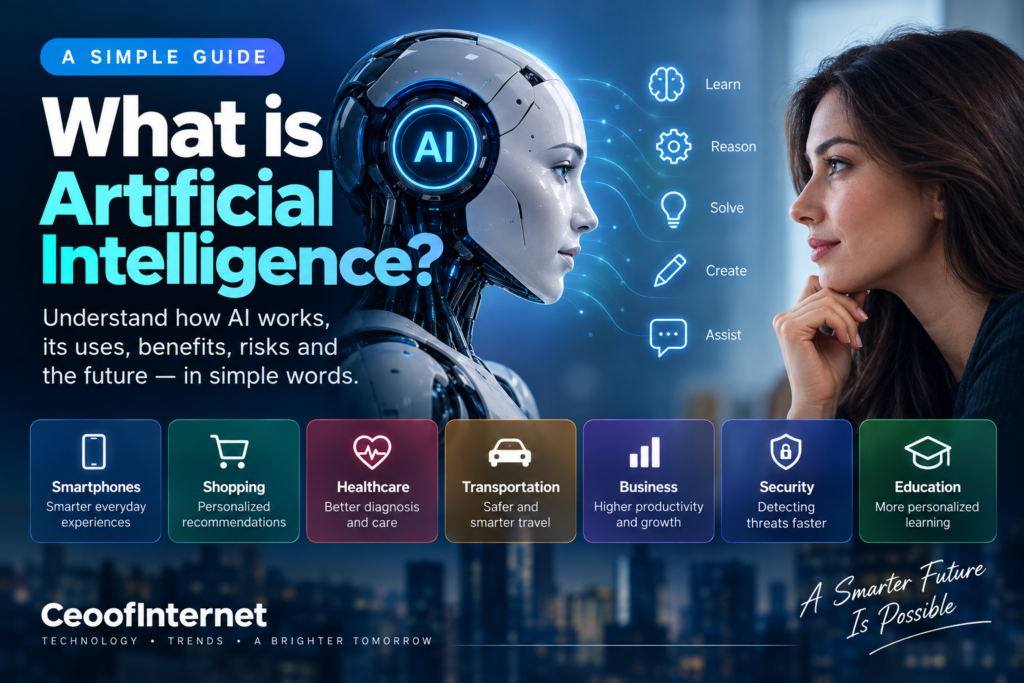
What Is Artificial Intelligence? A Simple Guide to AI, How It Works, and Its Uses
Artificial intelligence (AI) has moved from being a futuristic idea to becoming part of everyday life. Your phone can recognize your face, Google Maps can suggest routes, streaming services can recommend what to watch, and AI tools can generate text, images, audio, video and computer code.
But what is atificial intelligence, exactly? How does AI work, and what is the difference between AI, machine learning and generative AI?
This guide explains artificial intelligence in simple language, without requiring a technical background.
What Is Artificial Intelligence?
Artificial intelligence, commonly called AI, is a branch of computer science focused on creating computer systems that can perform tasks that normally require human intelligence.
These tasks can include:
- Learning from information
- Recognizing patterns
- Understanding language
- Analyzing images
- Making predictions
- Solving problems
- Recommending things
- Generating content
- Making decisions based on available information
The U.S. National Institute of Standards and Technology (NIST) describes an AI system as a machine-based system that can generate outputs such as predictions, recommendations or decisions based on objectives.
In simpler terms, AI allows computers to perform certain tasks in ways that resemble aspects of human intelligence.
How Does Artificial Intelligence Work?
AI isn’t one single technology. Modernn AI systems generally rely on a combination of data, algorithms, models and computing power.
A simplified process looks like this:
Data → Training → AI model → Input → Prediction or output
For example, imagine you want a computer to recognize cats.
You could provide it with thousands or millions of images containing cats and other objects. During training, an AI model learns patterns in the data that help it distinguish cats from other objects.
Once trained, the model can analyze a new image and estimate whether it contains a cat.
This is fundamentally different from manually programming a computer with a rule for every possible cat.
Google explains the concept similarly: AI systems can learn patterns from large amounts of data and use those patterns to make predictions or decisions.
Artificial Intelligence vs. Traditional Computer Programs
A traditional computer program usually follows instructions written explicitly by a programmer.
For example:
If temperature > 30°C → display “Hot”
The programmer has defined the rule.
An AI system can instead learn patterns from examples.
For example:
Thousands of weather observations → AI learns relationships → AI predicts temperature or weather conditions
This ability to learn patterns from data is one reason modern AI has become so powerful.
However, AI isn’t necessarily “thinking” like a human. An AI model processes information according to the architecture, training and objectives it was designed for.
What Is Machine Learning?
Machine learning (ML) is a major subset of artificial intelligence.
Instead of programming every rule manually, machine-learning systems learn patterns from data and use those patterns to make predictions or decisions.
For example, a bank could use machine learning to identify potentially fraudon history
It can then estimate whether a transaction looks unusual.
AI vs. Machine Learning
Think of it this way:
Artificial Intelligence → Machine Learning → Deep Learning
Machine learning is therefore part of AI, rather than a completely separate technology.
What Is Deep Learning?
Deep learning is a subset of machine learning that uses neural networks containing multiple layers.
These systems can learn complicated patterns from very large datasets.
Deep learning has become particularly important for:
- Image recognition
- Speech recognition
- Natural language processing
- Computer vision
- Generative AI
IBM explains that deep learning uses multilayer neural networks and is particularly suited to identifying complex patterns in large datasets.
A simplified hierarchy looks like this:
Artificial Intelligence → Machine Learning → Deep Learning
Not every AI system uses deep learning, but many of today’s most advanced AI applications rely on it.
What Is Generative AI?
Generative AI is a type of artificial intelligence capable of creating new content in response to instructions or prompts.
Depending on the model, that content can include:
- Text
- Transaction amount
- Location
- Time
- Purchasing patterns
- Device information
- Previous transaction history
- Image recognition
- Speech recognition
- Natural language processing
- Computer vision
- Generative AI
- Image recognition
- Speech recognition
- Natural language processing
- Computer vision
- Generative AI
- Text
- Images
- Video
- Audio
- Music
- Computer code
- Writing and research
- Image generation
- Video generation
- Voice generation
- Coding
- Document analysis
- Face recognition
- Camera image processing
- Voice assistants
- Predictive text
- Photo organization
- Translation
- Customer support
- Data analysis
- Marketing
- Software development
- Document processing
- Forecasting
- Automation
- Analyze millions of pieces of information
- Generate an article in seconds
- Recognize objects in images
- Write computer code
- Produce incorrect information
- Misinterpret a question
- Reflect biases in its training data
- Fail in unfamiliar situations
- Give an answer that sounds confident but is wrong
- Privacy
- Security
- Bias
- Misinformation
- Deepfakes
- Copyright and intellectual property
- Job displacement
- Incorrect AI-generated information
- Lack of transparency
- Overreliance on automated systems
- IBM’s Artificial Intelligence guide — Detailed explanation of AI, machine learning, deep learning and generative AI.
- Google Cloud’s AI guide — Beginner-friendly explanation of AI and its applications.
- NIST AI Risk Management Framework — Official resource on responsible AI and AI risk management.
- NIST AI glossaryy — Technical definitions of artificial intelligence.
For example, a bank could use machine learning to identify potentially fraudulent transactions. The system might analyze factors such as It can then estimate whether a transaction looks unusual. Think of it this way: Artificial Intelligence → Machine Learning → Deep Learning Machine learning is therefore part of AI, rather than a completely separate technology. Deep learning is a subset of machine learning that uses neural networks containing multiple layers. These systems can learn complicated patterns from very large datasets. Deep learning has become particularly important for: IBM explains that deep learningarning → Deep Learning Machine learning is therefore part of AI, rather than a completely separate technology. Deep learning is a subset of machine learning that uses neural networks containing multiple layers. These systems can learn complicated patterns from very large datasets. Deep learning has become particularly important for: IBM explains that deep learning uses multilayer neural networks and is particularly suited to identifying complex patterns in large datasets. A simplified hierarchy looks like this: Artificial Intelligence → Machine Learning → Deep Learning Not every AI system uses deep learning, but many of today’s most advanced AI applications rely on it. Generative AI is a type of artificial intelligence capable of creating new content in response to instructions or prompts. Depending on the model, that content can include: For example, a generative AI system can receive a prompt such as It can then generate a response based on patterns learned during training. Generative AI is one of the biggest developments in the current AI boom. IBM describes generative AI as deep-learning-based technology capable of creating content such as text, images, video and audio. Examples include AI toolls for: Large language models, commonly called LLMs, are a major category of AI models used for understanding and generating human language. An AI model is essentially a trained computational system that has learned patterns from data. Imagine showing a student millions of examples of written sentences and allowing them to learn how words and language relate to each other. An AI language model doesn’t learn exactly like a human, but the analogy helps explain the basic idea. During training, an AI model adjusts internal parameters based on enormous quantities of data. Once trained, it can process new inputs and produce outputs based on patterns it has learned. Google Cloud describes an AI model as a program or algorithm trained on data so that it can learn patterns and relationships and use them when processing new information. You probably interact with AI more often than you realize. AI can power features such as: Search engines use sophisticated algorithms and AI-related technologies to understand queries, content and user intent. Netflix, YouTube and music services can use recommendation systems to suggest content based on patterns in user behavior. Navigation applications can analyze traffic and other information to estimate journey times and suggest routes. E-commerce websites use recommendation systems to suggest products that may be relevant to individual shoppers. AI is being researched and deployed for applications including medical imaging, drug discovery, clinical decision support and administrative tasks. However, healthcare AI requires particularly careful validation because incorrect outputs can have serious consequences. Financial institutions can use machine learning and other AI techniques for fraud detection, risk analysis and customer-service applications. AI can help identify unusual patterns and potential threats across large volumes of data. Companies increasingly use AI for: Artificial intelligence isn’t new. Researchers have been working on AI for decades. The recent explosion in AI capabilities has been driven by several developments: Modern processors and specialized AI hardware can perform enormous numbers of calculations. The internet and digital services have produced enormous quantities of text, images, video and other data. Advances in machine learning and neural-network architectures have dramatically improved what AI systems can accomplish. Researchers have developed increasingly sophisticated approaches for training large models. The emergence of powerful generative models has made AI accessible to ordinary users through simple interfaces. Google Cloud notes that advances in computing power, massive datasets and deep-learning breakthroughs have contributed to the modern AI boom. No. AI can perform impressive tasks, but that doesn’t mean it has human intelligence in the same sense that people do. Modern AI systems can be extremely capable within particular tasks while still making mistakes that a human might find obvious. For example, an AI system can: Yet it can also: This is why AI-generated information should be checked, particularly when the subject involves medicine, law, finance, safety or other high-stakes decisions. AI can provide several important benefits. AI can process enormous amounts of information much faster than humans in many tasks. Repetitive tasks can potentially be automated, allowing people to concentrate on higher-value work. AI can help provide recommendations tailored to individual users. AI tools can help people translate languages, generate captions, summarize information and interact with computers using natural language. AI can assist researchers in analyzing complex datasets and accelerating certain areas of discovery. AI also creates significant challenges. Some important concerns include: NIST’s AI Risk Management Framework emphasizes managing risks associated with AI while promoting trustworthy and responsible development and use. This is particularly important as AI becomes integrated into more areas of everyday life. The answer is more complicated than simply yes or no. AI is already automating certain tasks that humans previously performed manually. At the same time, AI is creating new tools and changing how existing jobs are performed. In many cases, the more realistic question isn’t: “Will AI replace humans?” but: “Which tasks will AI automate, and how will humans’ jobs change as a result?” Someone who knows how to use AI effectively may be able to accomplish certain tasks considerably faster than someone who doesn’t. That means AI literacy is increasingly becoming a useful skill across many industries. AI is likely to become tive AI application based on large AI models designed to understand and generate natural language. AI can provide substantial benefits, but it also introduces risks involving areas such as privacy, security, misinformation, bias and misuse. The level of risk depends heavily on how an AI system is designed and used. Not in the human sense. AI systems can perform tasks associated with intelligence, but their underlying operation is based on computational models trained and designed to process data. Artificial intelligence is no longer just a concept from science fiction. It is already embedded in many of the products and services people use every day. Understanding the basics—AI, machine learning, deep learning, generative AI and AI models—makes it much easier to understand the rapidly changing technology landscape. The most important thing to remember is that AI is a tool. Its usefulness depends not only on how powerful the technology becomes, but also on how responsibly and intelligently people use it. Also explore on CeoofInternet: Learn AI and more posts in Artificial Intelligence.AI vs. Machine Learning
What Is Deep Learning?
What Is Deep Learning?
What Is Generative AI?
Popular examples of generative AI
What Is an AI Model?
Where Is Artificial Intelligence Used?
1. Smartphones
2. Search Engines
3. Streaming Services
4. Navigation
5. Online Shopping
6. Healthcare
7. Banking
8. Cybersecurity
9. Businesses
Why Has AI Become So Powerful Recently?
More computing power
More data
Better algorithms
Improved training techniques
Generative AI
Is AI the Same as Human Intelligence?
What Are the Advantages of Artificial Intelligence?
Speed
Automation
Personalization
Accessibilityy
Scientific research
What Are the Risks of Artificial Intelligence?
Will Artificial Intelligence Replace Humans?
What Is the Future of Artificial Intelligence?
Is AI dangerous?
Does AI think like a human?
Final Thoughts
Further reading
