
One Guy, $10K of AI Tokens, a Playable Taipei: What “Taipei GTA” Really Proves
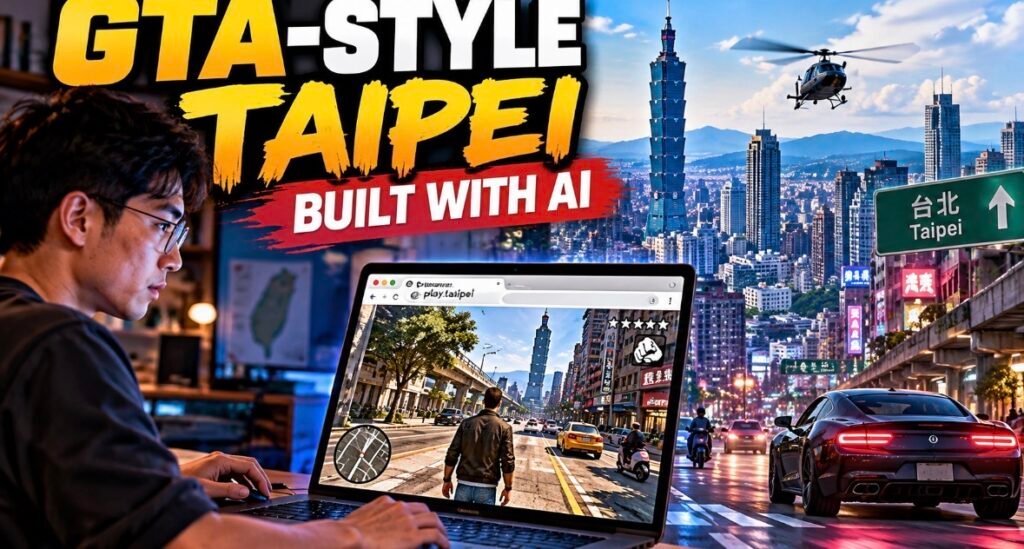
A guy in Taiwan with a day job just built a GTA-style open world set on the streets of Taipei that runs right in your browser, and he says it took about a month of evenings and more than $10,000 in AI tokens.
That’s the story behind Taipei GTA, the free browser game that’s been all over Threads and Taiwanese TV this past week. Tom’s Hardware picked it up on October 4 with a headline saying it hit 1.2 million concurrent players in three days.
I went through the Taiwanese coverage to figure out what’s solid and what isn’t. Short version: the game is real, the $10K is his own claim, and the 1.2 million number needs a closer look than it’s getting.
What Taipei GTA actually is
The official name is 臺北GTA:去臺北狂飆, roughly “Taipei GTA: Go Wild in Taipei.” It runs at taipei-gta.vercel.app. No download, no account, and there’s an English toggle in the top right.
You start on foot near Ximending with NT$500 in your pocket, about $16. From there it’s classic GTA stuff. Steal a scooter, run a red light, get chased by cops. You can also do some very Taipei things:
- Buy NT$13 tea eggs at a parody convenience store called “7-TWELVE” to heal
- Ride an elevator to the 89th floor of Taipei 101
- Take delivery and taxi jobs, enter scooter races, hunt for 30 hidden lucky cats
- Play a story about saving your grandma’s old street in Wanhua from a redevelopment crew
4Gamers counted 93 missions from the game’s own stats on September 29. Another guide counted 69 in the in-game mission list on October 1, so the number depends on how you count. Either way, there’s a lot here.
It looks like an early-2000s game. Low-poly buildings, simple lighting. Tom’s Hardware’s reviewer compared it to San Andreas and got 100+ FPS on a laptop’s integrated graphics. The page itself runs on Three.js, a popular JavaScript library for 3D in the browser. You can see it in the game’s own error message when WebGL fails to load.
Who made it
The creator goes by @aicodewithme on Threads. He posted the game on September 28 with a pretty blunt pitch. Here it is translated: “I really made a Taipei version of GTA. To make it, I’ve already burned more than US$10,000 in AI tokens… and it’s not a demo. It’s free to play right now.”
In a TV interview with Taiwan’s Mirror Media, he said he works a regular job and only builds after work, “about a month, 5 to 6 hours a day.” He said a “200-strong AI army” helped him research the streets and then write the game, and the hard part was stepping in when the AIs “conflicted” or “argued” with each other.
His reason for making it free? He wants more people to know Taiwan, and to remind people of happy times with their families there.
One wrinkle. Tom’s Hardware described the game as built on a coding platform called AICodeWith, which offers DeepSeek, Qwen, Kimi, GLM and other models. It guessed the whole thing might be a showcase for that platform. The Taiwanese outlets describe a solo engineer. I couldn’t confirm a link between the Threads account and the platform, so treat that part as open.
What $10,000 of AI tokens buys now
If you’ve read my explainer on generative AI, you know a “token” is basically the unit AI companies bill you by. Every chunk of text or code the model reads or writes costs tokens.
So here’s my rough math. A month at 5 to 6 hours a day works out to about 150 to 180 hours if he never took a night off. Spread $10,000 across that and he was burning something like $55 to $65 of AI per hour, on top of his own time.
That sounds like a lot until you compare it to people.
| What you’re paying for | Traditional way | Taipei GTA way |
|---|---|---|
| Code | A team of programmers | AI models, directed by one person |
| Street research | Designers and location scouting | About 200 AI agents, per the creator |
| Timeline | Months to years | About a month of evenings |
| Visible cost | Salaries, tools, offices | Over $10K in tokens (his claim) |
To be fair, he hasn’t published a cost breakdown, and he hasn’t said which AI tools he used. ETtoday reported he used more than 300 million tokens of OpenAI models. TechNews guessed at tools like Claude or GPT for code and 3D generators for models, but it said clearly that was a guess. Nobody outside knows the exact stack.
What I can say is that this is what an AI agent setup looks like when somebody really leans into it. One person stops being the coder and becomes the manager. Honestly, that’s a different job, and it’s not an easy one. Running 200 agents that argue with each other is a skill.
Reading “1.2 million concurrent” carefully
This is where I’d slow down.
The number comes from a TVBS news headline that roughly says 1.2 million people were playing at the same time. Tom’s Hardware ran it through machine translation and repeated it. That’s the whole chain. I haven’t found any public player tracker, dashboard screenshot or server data behind it.
Now look at the other numbers from the same week:
- Mirror Media reported the game passed 200,000 players after its first day.
- The original Threads post had around 1.3 million views by the morning of September 30, according to Taiwan News Wire.
- A later guide put the post past 1.9 million views.
Concurrent means at the same moment. 1.2 million people in one free browser game at once, three days after a Threads post, would be a massive number. Big studios brag about peaks like that.
Could it be true? Sure. Free plus no download spreads fast. But it’s also very possible the figure got mixed up somewhere between total players, visits and simultaneous players. Browser games don’t have a public counter the way Steam games do, so nobody can check.
My take: the game is clearly a hit in Taiwan. “1.2 million concurrent” is a TV headline, not a verified stat.
What this means if you build stuff alone
This is the part I care about most.
Specific beats generic
AI-made game demos are everywhere right now. This one went viral because of tea eggs, scooters in arcade walkways and cram school signs. Players kept saying how Taiwanese it felt. AI made the building cheap. The local detail made people share it.
Free and in the browser removes every excuse
No install, no store approval, no account. A link on Threads is the whole funnel. If you’ve wondered how cheap hosting is these days, my cloud computing guide covers why a solo dev can put something like this on Vercel at all.
Ship rough, then build in public
He told players he’d try to add the most-liked suggestion to the game that same weekend. He’s already teasing a Taichung version, high-speed rail and Taoyuan Airport. Fans get to feel like co-owners, and that keeps them coming back.
The catch
I don’t want to oversell this. There are real problems.
The name. “GTA” is Rockstar’s trademark. The game’s main menu says all brands in it are “fictional parody,” and Tom’s Hardware flagged that the name could bring legal trouble. No lawsuit has been reported as of today. Still, with GTA 6 launching November 19, I’d rename it before someone makes me.
Servers. Viral traffic isn’t free. The main menu has a donate button, and 4Gamers says donations help with development and server costs. A free game with no ads and a $10K bill already behind it has to figure out money eventually.
Polish. 4Gamers ran into black blocks, broken textures, loading waits and crackly music. Mobile quality is rough enough that the dev himself says to use a PC. The street layout is a neat grid, not the real Taipei.
Staying power. Novelty fades fast online. The test is whether people still play in a month, after the TV segments stop.
So did one guy beat a studio? No. He made a charming, buggy, very local game that a few years ago would’ve needed a team. That’s still a big deal.
FAQ
Is Taipei GTA free to play?
Yes. It runs in your browser at taipei-gta.vercel.app with no download or sign-up. It works on phones, but the developer recommends a computer for better graphics.
Is Taipei GTA made by Rockstar?
No. It’s an unofficial fan-made game inspired by Grand Theft Auto. Its main menu describes the brands in it as fictional parody.
Did it really cost $10,000 to make?
That’s the developer’s own claim. He said he spent over US$10,000 on AI tokens. He hasn’t published a breakdown or a full list of tools.
Did it really have 1.2 million players at once?
That figure comes from a Taiwanese TV report and hasn’t been independently verified. Other reports from the same week cited 200,000 players after day one.
What does “vibe-coded” mean?
It means building software mostly by describing what you want to AI models in plain language and letting them write the code. For more on how that works, see my piece on AI agents explained.
Sources: Tom’s Hardware, Mirror Media (mnews), 4Gamers, TechNews, ETtoday, NOWnews, Taiwan News Wire, Taiwan News Wire (follow-up), TVBS, nnyy.tw guide.
