
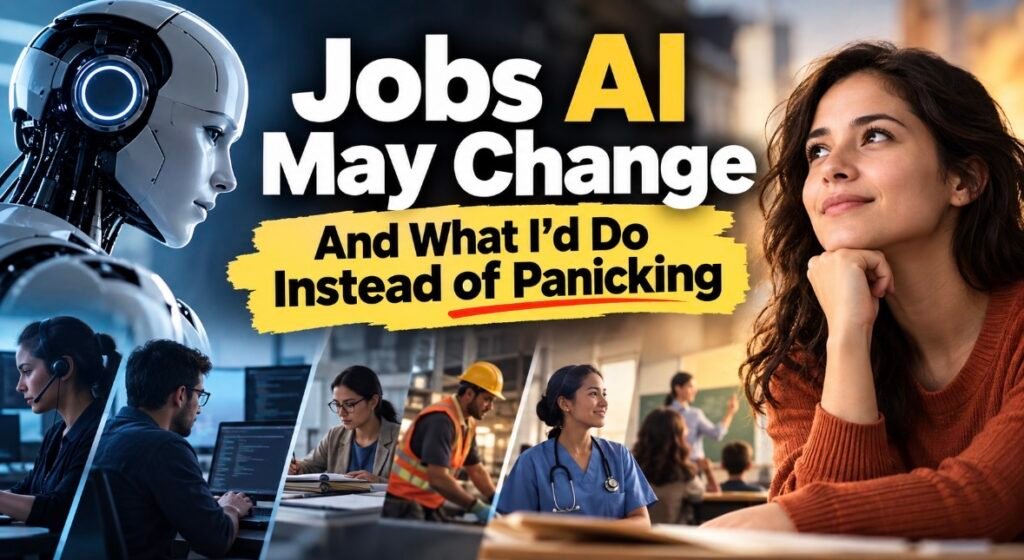
Jobs AI May Change — And What I’d Do Instead of Panicking
This January, the head of the IMF stood on a stage in Davos and called AI “a tsunami hitting the labour market.”
Lines like that travel. One ends up in your family group chat under a news link, with three crying emojis and a question nobody can answer: are we finished?
I get it. If you answer support tickets in Manila, keep the books for small shops in Lagos, translate contracts in Madrid or write code in Bengaluru, that headline hits differently.
So let’s slow down. Here are the jobs AI may change, how much they’ll change, and what I’d actually do about it. With real numbers.
First, what the big reports actually say
Short version: tasks are changing much faster than whole jobs.
- The IMF estimates almost 40% of global employment is exposed to AI. That’s about 60% in advanced economies, 40% in emerging markets and 26% in low-income countries. Exposed doesn’t mean fired. The IMF reckons roughly half of the exposed jobs in rich countries could actually benefit.
- The ILO’s 2025 update found one in four workers worldwide is in a job with some exposure to generative AI. Only 3.3% are in the highest-exposure group. The ILO’s verdict: transformation, not replacement, is the most likely outcome.
- The WEF Future of Jobs Report 2025 expects 170 million jobs to be created and 92 million displaced by 2030, a net gain of 78 million. Employers also expect 39% of workers’ core skills to change.
Now the fine print. That same WEF survey found 41% of employers expect to cut staff as AI gets better at doing roles. So, more jobs overall, and real pain for specific people.
The 4-bucket test: run it on your own job
Reports deal in averages. Nobody has an average job.
So here’s the self-check I’d use. Take a normal working week and sort your time into four buckets:
- Repeat screen work. Typing, copying, summarizing, formatting, answering the same question for the 40th time.
- Judgment. Deciding what to do when the answer isn’t obvious, and owning the call.
- Trust and relationships. People come back because it’s you. Clients, patients, students, your team.
- Hands and presence. Physical work in a real place. Fixing, lifting, driving, examining, caring.
Be honest with the percentages, then look at bucket one.
| Share of your week in repeat screen work | What it probably means |
|---|---|
| More than 60% | Your job will change a lot, and soon. Start now. |
| 30% to 60% | Your job will shift. The dull half shrinks and the rest matters more. |
| Less than 30% | AI will mostly be a helper. Learn it anyway. |
This isn’t science. It’s a flashlight. But it matches what the ILO keeps finding: clerical work is the most exposed category on the planet, while jobs built on physical work and human contact barely register.
The jobs AI may change most (and least)
Will change a lot
- Call centers and BPO. AI already drafts replies, summarizes calls and handles simple queries. A study of 5,179 support agents, mostly working in the Philippines, found an AI assistant lifted productivity 14% on average and 34% for newer, less skilled agents. Klarna said in 2024 its AI was doing the work of 700 agents. In 2025 its CEO admitted quality had slipped and said it would hire more humans. What stays human: the angry customer, the messy case, the sale.
- Data entry and clerical work. Cashiers, ticket clerks and administrative assistants sit among the WEF’s fastest-declining roles.
- Translators. Microsoft studied 200,000 Copilot conversations and ranked interpreters and translators first for AI applicability. First drafts become machine drafts. Human value moves to legal and medical accuracy, cultural nuance and live interpreting.
- Content writers. Generic filler costs almost nothing now. I write for a living, so this one’s personal. What survives is reporting, real expertise and an actual opinion.
- Bookkeepers. Accountants and auditors are on the WEF’s fastest-declining list too. Sorting receipts and reconciling accounts is getting automated. Advice, cleanup of messy books and keeping a nervous owner calm aren’t.
- Junior coders. In the US, employment of software developers aged 22 to 25 had fallen close to 20% from its 2022 peak by September 2025, while older developers kept growing, according to the Stanford AI Index 2026. Coding isn’t dying. The bottom rung of the ladder is.
Will shift
- Designers. For the first time, the WEF put graphic designers just outside its top 10 fastest-declining jobs. Resizing, variations and quick mockups go to AI. Taste, brand thinking and knowing what to leave out don’t.
- Paralegals and legal secretaries. Legal secretaries landed just outside that top 10 as well. Document review and first drafts speed up. Checking every citation matters more, because AI still makes things up.
- Office and support staff. Scheduling, minutes and routine emails are going first. AI agents that can finish multistep tasks are the next wave, so the role drifts toward coordinating people and fixing the software’s mistakes.
- Teachers. The WEF expects secondary and university teachers to be among the biggest job creators worldwide. Lesson planning and marking get faster. The person who notices a kid going quiet at the back stays.
Will mostly get help
- Radiologists. In 2016 Geoffrey Hinton said, “People should stop training radiologists now.” Since then, Mayo Clinic’s radiology staff has grown 55% to about 400, and the clinic uses more than 250 AI models.
- Nurses. Aging populations are pushing up demand for nursing professionals, says the WEF. AI note-taking tools have cut documentation time for some physicians by up to 83%, per the AI Index. Less paperwork, same hands-on care.
- Farmers. Farmworkers top the WEF’s list of largest-growing jobs, with 35 million more expected by 2030. Digital Green’s FarmerChat, which answers questions by voice, text or photo, has nearly 600,000 users across 120 countries. That’s AI as an advisor in your pocket, not a replacement.
- Drivers and trades. Delivery drivers and construction workers are among the WEF’s largest-growing roles. Robots are improving (I’ve written about whether the robot ChatGPT moment may be coming), but the AI Index found they succeed at only 12% of real household tasks. Robotaxis already run in a few cities, so drivers shouldn’t get complacent. Plumbers and electricians will get help diagnosing faults. They’ll still hold the wrench.
Rich countries vs developing economies
This isn’t one global story.
Exposure follows income. The ILO puts exposure at 34% of jobs in high-income countries and 11% in low-income ones. Sounds like good news for poorer countries, and partly it is. But the IMF warns many of them lack the infrastructure and skills to grab the benefits, which could widen the gap between nations.
Outsourcing hubs are on the front line. The Philippine IT-BPM industry had 1.9 million workers in 2025, up 4% on the year, and its industry body calls India and the Philippines the major players. An ILO study from July 2026 found 22.9% of jobs across Southeast Asia, nearly 80 million, have more than minimal exposure. Its headline finding, though, was “limited disruption” so far. The risk is simple: work that moved offshore because it was cheaper could move to software for the same reason. The opportunity is moving up to the complicated work AI can’t handle alone.
Informal work is a different world. The ILO expects 2.1 billion people to be in informal jobs in 2026. Street vendors, tailors, market traders, motorbike taxi riders. AI barely touches the core of those jobs. It can still help with prices, translation and paperwork.
Mobile-first users can leapfrog. For many people, the first AI tool is on a phone, often used by voice. In a survey of Kenyan FarmerChat users, 83% said it was their first time using a service like it. Generative AI reached 53% population adoption within three years, says the Stanford AI Index. Singapore is at 61%. The US ranks 24th, at 28.3%. Being rich doesn’t automatically put you ahead.
What I’d do instead of panicking
Here’s my plan. It’s boring on purpose.
- Audit myself first. If I ran the 4-bucket test on my own work, the research and formatting side of blogging would land squarely in bucket one. That’s where I’d start.
- Hand AI the dull stuff on purpose. Be the person on your team who already knows how.
- Grow the buckets AI can’t fill. Volunteer for the judgment calls. Talk to customers. Be in the room.
- Keep receipts. A simple note of results: hours saved, mistakes caught, clients kept.
- Make no big moves out of fear. No rage-quitting. No pricey course bought at 2 a.m.
Your “this month” list
All free. All doable on a phone.
- Week 1: Track your work in your notes app. Tag each task R, J, T or H, one letter per bucket.
- Week 2: Take your most repeated task and try it with a free chatbot like ChatGPT, Gemini, Copilot or Meta AI. Don’t paste in private or client data.
- Week 3: Write down every place the AI got it wrong. That list is your value.
- Week 4: Start Elements of AI, a free course from the University of Helsinki and MinnaLearn with over 2 million learners. Or catch up on the basics of what artificial intelligence actually is.
- End of the month: Add one true line to your CV, like “Used AI to cut weekly reporting from three hours to one.”
It costs nothing, whether you earn in pesos, rupees, naira, euros or pounds.
If you’re just starting your career
I won’t sugarcoat it: this is the hardest spot. “Tasks that are eliminated are usually what entry-level jobs do at present,” Kristalina Georgieva said in Davos. The ILO has flagged educated young people in rich countries hunting for their first high-skill job.
But remember that call center study: the newest agents gained the most. Used well, AI can compress years of learning into months.
If I were 22, I’d:
- Build proof, not just certificates. Small public projects beat a stack of PDFs.
- Lean toward paths that mix tech with people or the physical world: nursing, trades, sales, teaching, farm tech.
- Get really good at checking AI’s work. A junior who catches its mistakes is worth hiring.
- Keep the fundamentals. You can’t spot a wrong answer in a field you never learned.
My honest take
Most of the scary numbers measure exposure, not job losses. Microsoft said so about its own study. The ILO says the same about its own index.
But I’m not going to pretend nothing’s happening. Klarna shrank from about 5,000 people to almost 3,000, partly through AI and partly by not replacing people who left. Young developers in the US are already feeling it.
So here’s where I land. AI won’t delete your job on a random Tuesday. It’ll nibble at your tasks for years. People who notice the nibbling early and move toward judgment, trust and real-world work will be fine. Probably better than fine.
Panic makes you freeze. A plan gets you moving.
FAQ
Which jobs is AI most likely to change?
Clerical and admin work first, then call centers, translation, bookkeeping, generic content writing and entry-level coding. The ILO consistently finds clerical work has the highest exposure worldwide.
Will AI take my job completely?
Probably not overnight. The ILO says transformation, not replacement, is the most likely outcome. Still, 41% of employers in the WEF survey expect to cut staff because of AI, so some roles will shrink.
Which jobs are safest from AI?
Work that mixes people with physical presence. The WEF expects farmworkers, delivery drivers, construction workers, nurses and teachers to be among the biggest growth areas by 2030.
Are developing countries less affected by AI?
Less exposed right now. The IMF puts exposure at 26% of jobs in low-income countries versus about 60% in advanced economies. Outsourcing hubs are the exception, and the bigger long-term risk is missing out on the benefits.
Do I need to learn coding to stay relevant?
No. Learn to use AI tools inside your own field and to check what they produce.
Sources: IMF blog (Jan 2024), IMF Staff Discussion Note, The Guardian on Georgieva at Davos, ILO 2025 refined index, ILO 2023 study, ILO on ASEAN, ILO Employment and Social Trends 2026, WEF Future of Jobs 2025: jobs outlook, WEF skills outlook, WEF workforce strategies, Stanford AI Index 2026, Stanford AI Index economy chapter, NBER, Generative AI at Work, Microsoft Research, CNBC on Klarna, Radiology Business on the NYT report, 60 Decibels on FarmerChat, Philstar on Philippine IT-BPM and Elements of AI.
