
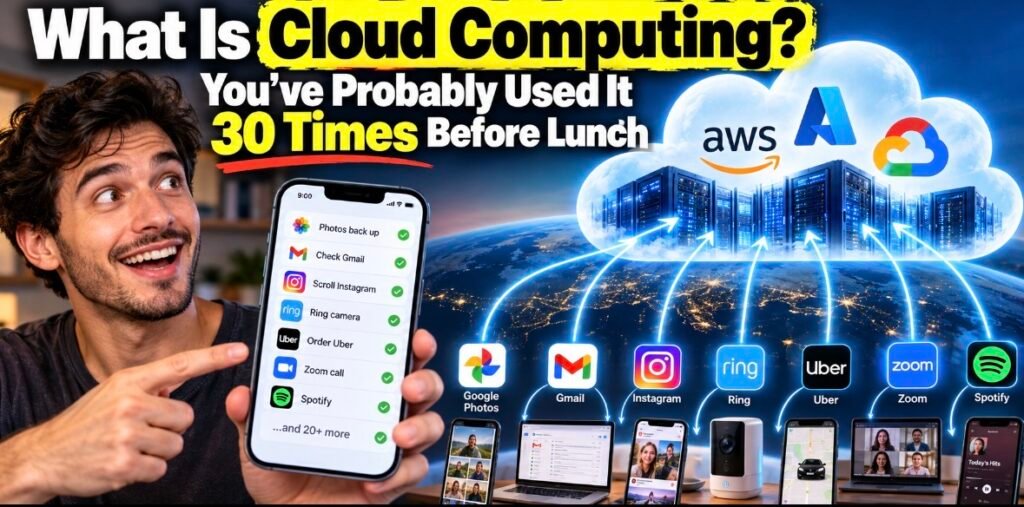
What Is Cloud Computing? You’ve Probably Used It 30 Times Before Lunch
Your alarm goes off. While you’re still squinting, your phone backs up last night’s photos to iCloud or Google Photos.
You check Gmail. Scroll Instagram. Peek at the Ring camera. Order an Uber, hop on a 9 a.m. Zoom call, and put Spotify on in the background.
Now count every time one of those apps talked to a server somewhere else. Hitting 30 before lunch is easy.
So, what is cloud computing? It’s the reason your phone didn’t have to do any of that heavy lifting itself.
What is cloud computing, in plain English?
Cloud computing means renting computing power, storage and software over the internet instead of owning and running it yourself.
That’s really it.
The official version comes from NIST, the US government’s standards agency. It calls cloud computing “on-demand network access to a shared pool of configurable computing resources” that can be spun up and released quickly. Translation: you get what you need, when you need it, and somebody else deals with the hardware.
Think of electricity. You don’t build a power plant in your backyard. You plug in and pay for what you use. The cloud does the same thing for computers.
And yes, you’ve probably seen the sticker: “There is no cloud. It’s just someone else’s computer.”
It’s true. I’ll come back to why that’s both the best and worst thing about it.
How cloud computing actually works
There are three moving parts.
1. Data centers
Warehouse-size buildings packed with servers, storage drives and a ridiculous amount of cooling. A big cluster sits in Northern Virginia, home to AWS’s heavily used us-east-1 region. Remember that name.
2. Virtualization
Software slices one physical server into many “virtual” machines. A bank’s app and a startup’s website might share the same box without ever seeing each other. That’s what makes renting work: you pay only for your slice.
3. The internet
The pipe. Your phone sends a request, a data center does the work, the answer comes back in a blink. Lose your Wi-Fi and “your” cloud disappears.
Fun one: Netflix finished moving its streaming service onto AWS in January 2016. Your account and billing run on Amazon’s cloud, but the video itself mostly comes from Netflix’s own Open Connect servers parked inside internet providers’ networks. Even the giants mix and match.
IaaS, PaaS and SaaS: the three flavors of cloud
This is where the jargon kicks in. My favorite way to think about it is housing.
- IaaS (Infrastructure as a Service) is renting an empty apartment. You get the walls, power and plumbing (servers, storage, networking). Furnishing it is your job. Examples: Amazon EC2, Azure Virtual Machines, Google Compute Engine.
- PaaS (Platform as a Service) is a furnished apartment. Developers just move in and build their app, without managing servers. Examples: Google App Engine, AWS Elastic Beanstalk, Heroku.
- SaaS (Software as a Service) is a hotel room. You show up and use it. Examples: Gmail, Zoom, Microsoft 365, Netflix.
| IaaS | PaaS | SaaS | |
|---|---|---|---|
| What you rent | Raw servers and storage | A ready-made platform to build on | A finished app |
| Who it’s for | IT teams and engineers | Developers | Pretty much everyone |
| You manage | Software, data, security setup | Your code and data | Your account and files |
| Familiar example | Amazon EC2 | Google App Engine | Gmail |
Most of us only touch SaaS. But every SaaS app sits on top of someone’s IaaS. Epic Games announced in 2018 it was going “all in” on AWS, so Fortnite runs on rented Amazon servers.
Public, private and hybrid clouds
Same idea, different levels of sharing.
- Public cloud: You rent from AWS, Microsoft or Google on shared infrastructure, like everyone else. Cheapest and most flexible.
- Private cloud: Cloud-style setup dedicated to one organization, either in its own building or hosted for it. Think banks, hospitals and government agencies with strict rules.
- Hybrid cloud: A mix of both. Zoom picked AWS as its preferred cloud in 2020, describing it as an extension of its own data centers. That’s hybrid in a nutshell.
Some companies also go multicloud. In 2023, Uber signed seven-year deals with both Oracle and Google Cloud so it could close its own data centers.
Who runs the cloud? AWS, Azure and Google Cloud
Three companies own most of it. According to Synergy Research Group, worldwide market share for cloud infrastructure services in Q2 2026 was:
- Amazon Web Services (AWS): 28%
- Microsoft Azure: 20%
- Google Cloud: 15%
Total spending hit $143 billion in that single quarter, up 43% from a year earlier. Per CRN’s breakdown of Synergy’s data, AWS slipped from 30% a year earlier while Google climbed from 13%.
AWS is still the giant, just not running away with it anymore. Newer “neoclouds” like CoreWeave and Nebius are growing fast too, mostly by renting out AI chips.
Which brings us to the real story.
Why AI made the cloud exciting again
For about a decade, the cloud was boring plumbing. Nobody talked about it at dinner.
Then generative AI showed up.
Training and running AI models takes enormous numbers of GPUs, the specialized chips that are expensive and hard to get. Most companies can’t buy thousands of them. So they rent. When you type a prompt into ChatGPT or Gemini, the heavy work happens in a data center, not on your phone. (New to this? Start with what artificial intelligence actually is and then how generative AI works.)
Synergy says GenAI has been the primary driver of the cloud’s recent growth, with GenAI-specific services growing 165% year over year. Its chief analyst, John Dinsdale, put it simply: “AI technology has lit a fire under the cloud market.”
And it’s about to get hungrier. AI agents don’t just answer one question. They work through multistep tasks, which means more computing per job.
The backlash
All those GPUs need power. A lot of it.
A Lawrence Berkeley National Laboratory report found US data centers used about 4.4% of the country’s electricity in 2023. It projected that could climb to between 6.7% and 12% by 2028.
Neighbors have noticed. Complaints about power bills, water and secrecy keep piling up. New York announced a one-year moratorium on permits for large data centers. AWS CEO Matt Garman says more than 100 data center moratoriums are being considered across the US.
On October 3, 2026, TechCrunch reported Garman’s blog post saying Amazon no longer uses nondisclosure agreements with the government agencies it works with on these projects. Honestly? Good. Local officials signing NDAs before neighbors even knew a project existed should never have been normal.
Some companies are literally looking up. Google sent AI chips into orbit in October 2026 to test Project Suncatcher, its data-centers-in-space idea.
The good stuff
- No big upfront cost. A startup can launch without buying a single server.
- It scales on demand. Zoom went from 10 million daily meeting participants in December 2019 to more than 300 million a day by April 2020, adding thousands of AWS virtual servers in a single day when it needed to.
- Your stuff follows you. Drop your phone in a lake, buy a new one, sign in. Photos are back.
- It’s usually more reliable than a server in a closet. Usually.
The real downsides
Outages hit everyone at once
On October 20, 2025, a bug in AWS’s automated DNS system in us-east-1 cascaded across its services. Fortnite, Snapchat, Venmo, Roblox, Signal and Alexa all stumbled. AWS’s own timeline puts the full event at roughly 15 hours.
Then on May 7, 2026, a cooling failure in a single us-east-1 data center made servers shut themselves down to avoid overheating. Some customers waited more than a day for everything to recover.
The CrowdStrike mess on July 19, 2024 is a little different. It wasn’t a cloud outage, exactly. A faulty update from a cloud-delivered security tool crashed about 8.5 million Windows devices, by Microsoft’s estimate. Delta alone canceled more than 5,500 flights.
Same lesson, though. When everyone depends on the same few vendors, one mistake travels fast.
Lock-in
Once your apps and data are built around one provider’s tools, moving is slow and pricey. That’s by design.
The bill that never ends
This is my personal pet peeve. In the US, iCloud gives you 5GB free. Then it’s $0.99 a month for 50GB, $2.99 for 200GB or $9.99 for 2TB. Google gives you 15GB shared across Gmail, Drive and Photos, then $1.99 a month for 100GB.
None of that sounds like much. But you don’t buy storage anymore. You lease it, every month, forever. Stack it next to your streaming apps and that AI subscription you forgot about, and it adds up.
Privacy and control
Your data lives on someone else’s computer, under their security, their policies and their response to legal requests. Usually that’s fine. Just know it.
Should you care?
If you’re a regular person: yes, a little.
- Check what you’re paying for storage. A lot of families pay for iCloud and Google One without realizing it.
- Turn on backups. Your phone will die someday.
- Keep one offline copy of the irreplaceable stuff, like wedding photos and tax records, on an external drive.
If you run a small business: definitely.
- Use SaaS tools like Google Workspace, Microsoft 365 or QuickBooks Online instead of running your own servers.
- If you rent from AWS, Azure or Google Cloud directly, set up billing alerts on day one.
- Before signing up for anything, find out how you’d export your data if you leave.
My honest take
“It’s just someone else’s computer.” Sure. That’s the whole deal.
It’s a better computer than mine, run by people better at it than me. I’m happy to rent it.
But renting means you’re a tenant. The landlord sets the price, picks the rules, and when the building’s AC fails in Virginia, you wait like everybody else.
Use the cloud. Just keep a spare key.
FAQ
What is cloud computing in simple terms?
It’s using computing power, storage or software over the internet instead of your own hardware. You rent it; the provider runs the machines.
What are examples of cloud computing I use every day?
Gmail, iCloud and Google Photos backups, Netflix, Zoom, Uber, Spotify and online games like Fortnite all depend on cloud servers.
Is my data safe in the cloud?
Big providers usually protect data better than you can at home, but breaches and outages still happen. Use a strong password, turn on two-factor authentication and keep an offline backup.
What’s the difference between the cloud and the internet?
The internet is the network that connects everything. The cloud is the computers and services you reach through that network.
Who is the biggest cloud computing company?
Amazon Web Services. Synergy Research Group put AWS at 28% of the worldwide cloud infrastructure market in Q2 2026, ahead of Microsoft at 20% and Google at 15%.
Sources: NIST SP 800-145, Synergy Research Group, CRN, Netflix, Netflix Open Connect, Amazon on Epic Games, Amazon on Zoom, DCD on Uber, Berkeley Lab, TechCrunch, AWS outage summary via postmortem.io, Engadget, Network World, Reuters, AP, Apple and Google One.
